

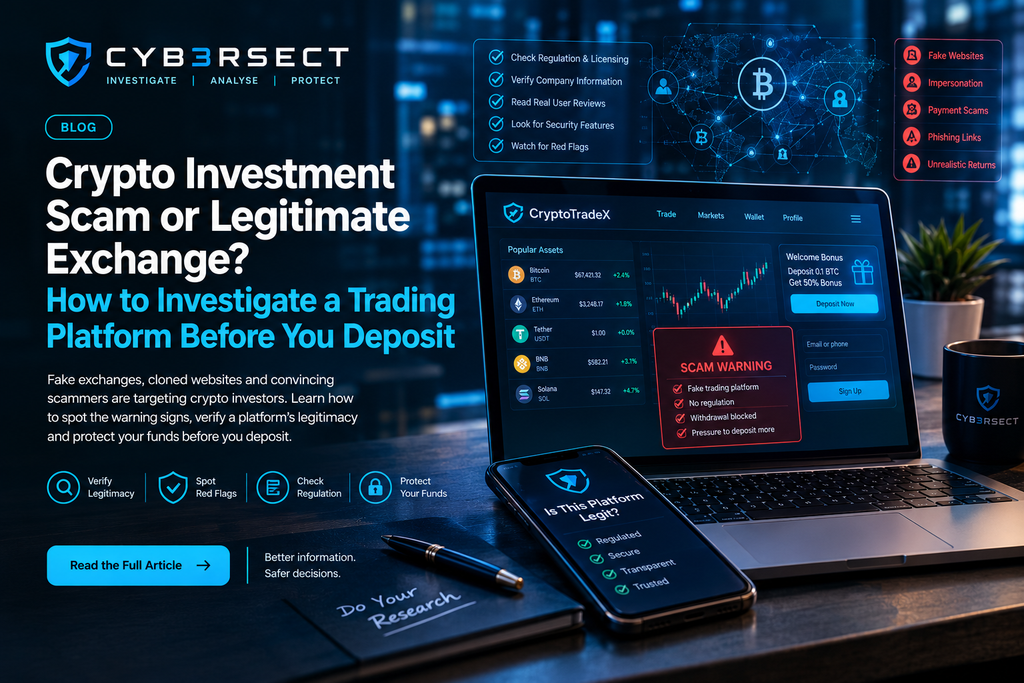
Crypto Investment Scam or Legitimate Exchange? How to Investigate a Trading Platform Before You Deposit
Cryptocurrency has created new opportunities for trading, investing and transferring digital assets. It has also created an environment in which fraudulent websites can imitate legitimate exchanges, investment companies and cryptocurrency services.
A platform may have a professional-looking website, a convincing trading dashboard, customer-support representatives and positive online reviews. It may even display account balances and apparent profits. None of these features, on its own, proves that the business is genuine or that customers can withdraw their funds.
For someone considering a cryptocurrency investment, the most important question is not simply whether a platform looks legitimate. It is whether its identity, business operations, regulatory status, technology and financial arrangements can be independently verified.
This distinction matters because fraudulent platforms often attempt to establish trust before requesting deposits. Once a person has transferred cryptocurrency or sent money through a payment provider, recovering control of those funds can become difficult.
At Cyb3rsect, we focus on digital investigations, online fraud intelligence and evidence-based analysis. This guide explains how to examine an unfamiliar cryptocurrency platform, identify warning signs and preserve useful information before making a financial commitment.
1. Start with the company’s identity, not its website design
A professional website is easy to create. Establishing a legitimate, accountable business is much harder.
Before depositing money, identify the legal entity that operates the platform.
Look for:
- The company’s full registered legal name.
- Its country and jurisdiction of incorporation.
- A verifiable registered business address.
- Company registration details.
- The names of directors or responsible officers, where publicly available.
- Clear terms of service identifying the contracting entity.
- Contact information that can be independently checked.
Do not assume that a company registration proves an investment business is authorised to provide financial services. Company incorporation and financial-services licensing are separate matters.
You should also check whether the legal entity named in the website’s terms matches the company named in its regulatory disclosures and payment instructions.
A mismatch does not automatically establish fraud, but it should be investigated before proceeding.
2. Verify regulatory claims independently
Some cryptocurrency platforms claim to be regulated, licensed, registered or authorised by a financial authority.
These terms are not interchangeable.
A company might be registered for ordinary business purposes without holding permission to provide the particular financial services it advertises. A registration number displayed on a website may also belong to another company.
To check a regulatory claim:
- Identify the regulator named by the platform.
- Visit the regulator’s official website independently.
- Search its public register for the exact legal entity.
- Compare the registered name, address and authorised activities.
- Check whether the permission covers the services being advertised.
- Look for warnings or restrictions published by the regulator.
Do not rely on a certificate or screenshot supplied by a salesperson. Verify the information directly through the regulator’s own records.
In the United States, the relevant authority depends on the activity and business model. Investors may need to consult resources from the Securities and Exchange Commission, Commodity Futures Trading Commission, Financial Crimes Enforcement Network or state financial regulators.
For example, the SEC’s public resources explain how investors can research investment professionals and identify potential warning signs. The CFTC also provides consumer information about virtual currency-related fraud.
A platform’s regulatory position should be checked against the actual services it offers, not simply the logos displayed on its website.
3. Investigate the website and its domain history
A website’s domain can provide useful investigative leads.
Check:
- When the domain was registered.
- Whether its registration details have changed.
- Whether the domain has been associated with other websites.
- Whether the site redirects visitors to unrelated domains.
- Whether the website’s claimed operating history matches available records.
- Whether the platform uses several similar domains.
A recently registered domain does not automatically mean a platform is fraudulent. New legitimate businesses launch websites every day.
However, a platform claiming to have operated for many years while using a recently registered domain deserves further examination.
Pay attention to spelling variations and lookalike domains. Fraudulent operators may create websites that closely resemble established exchanges or financial companies.
For example, a slight change in a domain name, additional word or unfamiliar extension may lead to a completely different website.
You should also be cautious when a representative sends you a link through a messaging application and insists that you use that exact address to log in or deposit funds.
4. Examine how the platform handles deposits and withdrawals
A cryptocurrency exchange should explain how customers deposit and withdraw assets.
Before investing, examine the published withdrawal process.
Questions worth asking include:
- Which cryptocurrencies and networks are supported?
- Are withdrawal fees clearly disclosed?
- Are minimum and maximum withdrawal limits explained?
- Are processing times published?
- Are customer assets subject to additional verification?
- Does the platform explain how withdrawal disputes are handled?
Be particularly cautious if a platform allows deposits but provides vague answers about withdrawals.
A major warning sign occurs when a customer is told that they must make another payment to release an existing balance. The payment may be described as a tax, verification charge, liquidity deposit, security bond or account-unlocking fee.
A legitimate tax obligation or service charge should be independently verifiable. Do not accept an explanation simply because it comes from someone claiming to be an account manager.
If a platform demands additional cryptocurrency before allowing a withdrawal, stop and independently verify the demand. Avoid sending more funds simply to recover an earlier deposit.
5. Be careful with trading dashboards and displayed profits
Some fraudulent investment websites use dashboards that display account balances, trading histories and apparent profits.
These screens can look convincing. However, a number displayed on a website is not independent evidence that the corresponding cryptocurrency exists or is available for withdrawal.
Ask yourself:
- Can the displayed transactions be independently verified?
- Are blockchain transaction identifiers provided where appropriate?
- Can the receiving wallet be identified?
- Does the platform explain how balances are calculated?
- Can a small withdrawal be completed without unexpected conditions?
- Are statements and account records consistent?
Even a successful small withdrawal does not prove that a platform is safe. Some fraudulent schemes may allow limited withdrawals to encourage larger deposits.
Likewise, a dashboard showing a growing balance does not prove that funds have been invested or that profits are real.
The important distinction is between a platform’s internal records and independently verifiable evidence.
6. Investigate the people promoting the investment
Fraudulent platforms are not always discovered through website research alone. The people promoting them may provide important investigative leads.
An individual may claim to be:
- A professional cryptocurrency trader.
- An investment adviser.
- A portfolio manager.
- A company director.
- A representative of a well-known financial institution.
- A member of a private investment group.
Check whether the person’s claimed identity and professional background can be independently verified.
Be cautious when a promoter uses a photograph or profile that appears elsewhere under a different name. Impersonation can involve copied biographies, fabricated professional histories and stolen photographs.
Also examine the way the person communicates.
Warning signs may include:
- Unsolicited investment offers.
- Pressure to deposit quickly.
- Claims of guaranteed or unusually consistent returns.
- Requests to keep the opportunity confidential.
- Attempts to move conversations away from official company channels.
- Instructions to install remote-access software.
- Requests for passwords, recovery phrases or authentication codes.
A genuine financial professional should be willing to explain their identity, organisation, services and regulatory position without pressuring you into an immediate transfer.
7. Search for independent warnings and complaints
Online research can help identify patterns, but it must be approached carefully.
Search the platform’s exact name, website address and legal company name alongside terms such as:
- Scam warning.
- Withdrawal problems.
- Regulatory warning.
- Impersonation.
- Fraud complaint.
- Account frozen.
- Unexpected fees.
Check official regulator warnings, law-enforcement announcements, court records and established consumer-protection sources where available.
Independent reviews can also provide leads, but individual reviews are not proof that a business is fraudulent or legitimate.
Be alert to review manipulation. A platform may have numerous positive reviews that are repetitive, recently published or written by accounts with little review history. Conversely, a negative review may be inaccurate or relate to a different business with a similar name.
Look for corroboration across independent sources rather than relying on one review website.
8. Examine the platform’s payment and wallet details
The destination of a payment can provide useful information.
If the platform asks you to transfer cryptocurrency, record the receiving wallet address and the blockchain network specified in the instructions.
Where appropriate, you can examine publicly available blockchain information to identify:
- The transaction identifier.
- The sending and receiving addresses.
- The amount transferred.
- The date and time recorded on the blockchain.
- Subsequent transfers visible on that network.
However, blockchain information has important limitations.
A wallet address does not automatically reveal the identity of the person controlling it. A transaction record also does not prove that a particular company owns or operates the destination wallet.
Avoid sending a test payment merely to investigate an unfamiliar address. You can often examine available public information without making a transfer.
If you have already sent cryptocurrency, preserve the transaction details and relevant correspondence.
Cyb3rsect’s guide to how to trace a cryptocurrency wallet provides a starting point for understanding blockchain transaction analysis. Use the available site resources to explore the investigation process before taking further action.
9. Recognise common cryptocurrency investment warning signs
No single warning sign proves that a platform is fraudulent. However, several warning signs occurring together can justify stopping the investment process and conducting further checks.
| Warning sign | Why it deserves attention |
|---|---|
| Guaranteed returns | Investments carry risk; guaranteed profit claims require scrutiny |
| Pressure to deposit immediately | Urgency can discourage independent verification |
| Unverifiable company details | Makes accountability difficult to establish |
| Unclear regulatory status | The business may not have the permissions it claims |
| Withdrawal restrictions | May indicate operational or financial problems |
| Unexpected release fees | Could be an attempt to obtain additional payments |
| Unsolicited investment messages | May involve impersonation or social engineering |
| Requests for remote access | Can expose personal accounts and devices |
| Payment to unrelated third parties | May obscure the actual recipient of funds |
| Multiple similar domains | Could indicate impersonation or a changing online identity |
The context matters. A legitimate platform can experience technical delays or customer-service problems. The purpose of these checks is to establish facts before taking financial risks.
10. What to do if you have already deposited money
If you have transferred funds to a platform and now suspect something is wrong, avoid making additional payments until the situation has been independently assessed.
Take these steps:
Stop further transfers. Do not pay additional fees or deposits simply because someone promises to release your existing balance.
Preserve communications. Save emails, messages, chat histories, telephone numbers and account-manager details.
Record the website information. Keep the exact domain, relevant page addresses, screenshots and any account identifiers.
Preserve transaction records. Save wallet addresses, transaction hashes, network information, exchange receipts and payment confirmations.
Contact the sending service. If you used a bank, card provider or cryptocurrency exchange, contact its official support channel promptly and explain what happened. Available options depend on the payment method and circumstances.
Secure your accounts. If you shared passwords, authentication codes or remote access, change affected credentials from a trusted device, revoke suspicious sessions and enable appropriate security protections.
Report the incident. Depending on your location and circumstances, relevant financial regulators, consumer-protection agencies and law-enforcement organisations may accept reports.
In the United States, the FBI’s Internet Crime Complaint Center (IC3), the Federal Trade Commission and relevant state authorities provide reporting channels for different types of online fraud.
Reporting does not guarantee that funds will be recovered, but it can help document the incident and provide information to authorities.
11. Beware of cryptocurrency recovery scams
People who lose money to an investment platform may become targets for a second fraud.
Recovery scammers often contact victims through social media, messaging applications or unsolicited emails. They may claim to be investigators, lawyers, government representatives or specialist recovery agents.
Common warning signs include:
- Guaranteed recovery of cryptocurrency.
- Claims of access to frozen wallets without verifiable authority.
- Requests for advance payments.
- Demands for wallet recovery phrases or private keys.
- Claims that a blockchain transaction can simply be reversed.
- Pressure to act before a supposed recovery deadline.
Blockchain transactions are generally not reversible through a normal customer-service request. Any claim that someone can guarantee the return of cryptocurrency should be examined carefully.
A legitimate investigation should explain its scope, evidence requirements, limitations, costs and reporting process. It should not promise an outcome that cannot be guaranteed.
12. How a digital investigation can help assess a suspicious platform
When a platform appears suspicious, an evidence-based investigation can help organise the available information and identify questions that need further examination.
Depending on the circumstances and authorised scope, an investigation may involve:
- Reviewing website content and domain information.
- Examining claimed business identities and regulatory disclosures.
- Analysing communications with platform representatives.
- Reviewing payment instructions and transaction records.
- Examining relevant blockchain activity.
- Identifying inconsistencies between company claims and available evidence.
- Building a chronological record of events.
- Documenting findings and limitations.
The goal is not to assume that every unfamiliar platform is fraudulent. It is to assess the evidence, identify inconsistencies and provide a clearer picture of what can and cannot be established.
Cyb3rsect’s work is focused on digital investigations, online fraud intelligence and evidence-focused analysis. The appropriate service depends on the case, available records, legal authority and technical requirements.
A practical checklist before depositing into a cryptocurrency platform
Before sending money, take time to complete these checks:
- Confirm the exact website domain.
- Identify the legal company operating the platform.
- Verify company information independently.
- Check relevant regulatory registers.
- Review the platform’s terms and withdrawal procedures.
- Examine the identity and claims of the people promoting it.
- Search for independent warnings and complaints.
- Understand the payment and wallet arrangements.
- Confirm that you are not being pressured into an immediate deposit.
- Never share private keys, recovery phrases or authentication codes.
If you cannot verify important information, pause before transferring funds.
Final thoughts: verify first, invest later
A convincing cryptocurrency website is not proof of a legitimate exchange. Professional branding, positive reviews, trading dashboards and promises of high returns can all be presented without demonstrating that a platform operates a genuine, accountable investment business.
The most important protection is independent verification.
Check the legal entity, examine regulatory claims, understand withdrawal arrangements, investigate the people promoting the opportunity and preserve evidence when something does not add up.
If you have already interacted with a suspicious platform, organised records can help establish what happened and support further reporting or investigation.
Cyb3rsect provides information and investigation-focused support relating to digital evidence, online fraud and cryptocurrency-related incidents. If you need help reviewing a suspicious platform or organising digital evidence, visit Cyb3rsect to learn more.
Cyb3rsect — Investigate. Analyse. Protect.
