

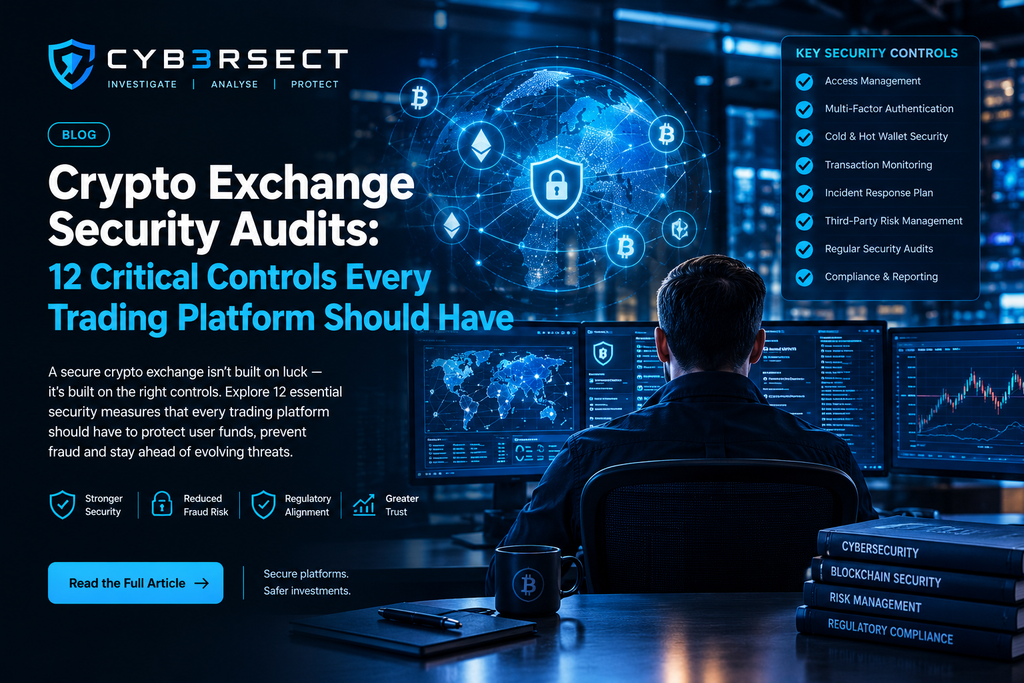
Crypto Exchange Security Audits: 12 Critical Controls Every Trading Platform Should Have
Cryptocurrency exchanges operate in an environment where security failures can have serious consequences. They manage customer accounts, digital assets, transaction systems, sensitive personal information and complex technology infrastructure. A weakness in one area can expose another, particularly when access controls, monitoring and operational procedures are not properly connected.
For traders and investors, choosing an exchange involves more than comparing fees, available coins and trading features. Security controls matter because they influence how a platform protects accounts, manages withdrawals, responds to suspicious activity and handles incidents.
For exchange operators, regular security assessments can help identify weaknesses before they become serious problems.
But what should a meaningful crypto exchange security audit actually examine?
A credible assessment should look beyond whether a website has HTTPS or whether users can enable two-factor authentication. It should consider the entire environment: employee access, wallet infrastructure, transaction approvals, cloud services, software development, monitoring, third-party integrations and incident response.
At Cyb3rsect, we believe security should be examined through evidence, practical controls and a clear understanding of how digital systems operate.
This guide explains 12 important security controls every cryptocurrency trading platform should assess.
1. Strong identity and access management
Access management is one of the foundations of exchange security.
Employees, administrators, contractors and automated services should only have access to the systems required for their responsibilities. A support employee should not automatically have access to infrastructure administration, while a developer should not receive unrestricted permissions to production wallet systems.
An exchange should maintain:
- Individual accounts for employees and contractors.
- Role-based access permissions.
- Restrictions on privileged accounts.
- Regular access reviews.
- Immediate access removal when roles change or employment ends.
- Monitoring of sensitive administrative activity.
Shared accounts should be avoided wherever possible because they make it harder to determine who performed a particular action.
An audit should also examine whether access permissions have expanded over time without proper review.
2. Multi-factor authentication and phishing resistance
Passwords alone are not sufficient protection for high-value exchange environments.
Multi-factor authentication adds another verification requirement, reducing the risk that a stolen password will be enough to access an account.
However, not all authentication methods provide the same level of protection. Phishing-resistant methods, such as appropriately configured hardware security keys or passkeys, can provide stronger protection against credential theft than codes entered into a fraudulent website.
An audit should assess:
- Whether MFA is required for privileged accounts.
- Whether administrators use phishing-resistant authentication.
- How recovery procedures are protected.
- Whether suspicious authentication attempts trigger alerts.
- Whether active sessions can be revoked.
- Whether authentication policies apply consistently across connected services.
A particularly important question is whether a compromised session can continue operating after a password reset. Organisations should understand how tokens, device sessions and access revocation work across their systems.
3. Secure cryptocurrency wallet infrastructure
Wallet security is central to the operation of a cryptocurrency exchange.
Platforms may use a combination of hot wallets, warm wallets and cold storage arrangements, depending on their operational and custody model. Each arrangement has different accessibility and security considerations.
An audit should establish:
- How private keys are protected.
- Which systems can request or authorise transactions.
- Whether key-management responsibilities are separated.
- How signing operations are monitored.
- Whether backup and recovery procedures are documented.
- How access to wallet infrastructure is restricted.
Cold storage can reduce exposure to online threats, but it does not remove every operational risk. Key generation, backup, access procedures and recovery arrangements still need careful management.
The audit should examine the complete process rather than simply confirm that an exchange claims to use cold wallets.
4. Independent transaction approval controls
A withdrawal should not depend on one employee or one compromised account having unrestricted authority.
Exchanges should implement appropriate approval controls for sensitive transactions. Depending on the platform’s architecture, these may include multi-party approval, transaction limits, withdrawal delays and additional verification for unusual requests.
A security assessment should consider:
- Whether high-risk withdrawals require additional approval.
- Whether transaction limits are configurable and monitored.
- Whether approval responsibilities are separated.
- Whether changes to withdrawal settings are logged.
- Whether emergency overrides are restricted and reviewed.
- Whether unusual transaction patterns trigger investigation.
The objective is to prevent a single compromised account from becoming sufficient authority for a critical financial operation.
5. Continuous transaction and withdrawal monitoring
Monitoring should identify unusual activity quickly enough for an organisation to investigate and respond.
A platform may need to monitor account behaviour, withdrawal patterns, destination addresses, login activity and changes to security settings.
Examples of activity worth reviewing include:
- A sudden change in withdrawal behaviour.
- Repeated failed authentication attempts.
- New withdrawal destinations followed by unusually large transactions.
- Unusual account access before a withdrawal.
- Rapid changes to account security settings.
- Activity that differs significantly from established account patterns.
Monitoring systems should not rely on a single fixed threshold. Risk scoring and contextual analysis can help distinguish unusual but legitimate behaviour from activity requiring intervention.
An audit should examine how alerts are generated, who receives them, how they are investigated and whether unresolved alerts are escalated.
6. Secure development and software deployment
Exchange platforms depend on software that is frequently updated. New features, infrastructure changes and security patches must be introduced without creating unnecessary exposure.
Development and production environments should be separated, and code changes should follow documented review and deployment procedures.
Important controls include:
- Code review before production deployment.
- Protected source-code repositories.
- Restricted deployment permissions.
- Secure management of software secrets.
- Dependency and vulnerability scanning.
- Change approval and rollback procedures.
- Monitoring of unusual deployment activity.
An audit should also examine developer access. A compromised engineering account should not automatically provide unrestricted control over production infrastructure.
For more context, read Cyb3rsect’s article on how hackers compromise crypto exchange employees.
7. Cloud infrastructure and configuration security
Cloud environments often support exchange websites, applications, databases, monitoring systems and internal services.
Misconfigured storage, excessive permissions, exposed management interfaces and poorly protected credentials can create opportunities for unauthorised access.
A cloud security assessment should examine:
- Identity and access permissions.
- Public exposure of storage and services.
- Network segmentation.
- Encryption settings.
- Secrets and credential management.
- Administrative access records.
- Logging and monitoring coverage.
- Backup configuration.
The assessment should include both production and development environments. A less protected development system can still become relevant if it shares credentials or network access with critical services.
Where cloud accounts may have been compromised, preserving relevant logs and configuration history can help establish what changed and when.
See Cyb3rsect’s cloud account forensics information for more on examining cloud-related digital evidence.
8. Endpoint and employee device protection
Employees access sensitive systems from laptops, workstations and mobile devices. These endpoints can become targets for phishing, malware, credential theft and unauthorised remote access.
An exchange should have a documented endpoint security programme.
This may include:
- Endpoint detection and response.
- Device encryption.
- Timely operating-system updates.
- Restrictions on local administrator privileges.
- Managed device policies.
- Secure remote access.
- Monitoring for suspicious processes.
- Procedures for lost or compromised devices.
An audit should check whether endpoint protection is actually deployed and monitored rather than simply listed in an internal security policy.
It should also examine whether personal devices are allowed to access sensitive systems and, if so, what controls apply.
9. Network segmentation and administrative access
Network segmentation limits the ability of an attacker to move freely between systems after obtaining initial access.
For example, a public-facing website, an internal development environment and a production wallet-management system should not necessarily share unrestricted network access.
A security review should assess:
- Separation of production and development networks.
- Restrictions on administrative interfaces.
- Secure remote-access gateways.
- Firewall rules and network policies.
- Monitoring of internal traffic.
- Controls around service-to-service communication.
- Access paths to sensitive infrastructure.
The purpose is to reduce the impact of a compromise. Even if one device or account is affected, segmentation can help prevent the incident from spreading into more sensitive areas.
10. Third-party and supplier security
Exchanges depend on external services, which may include cloud providers, identity platforms, analytics services, payment processors, software vendors and outsourced technical teams.
These relationships can introduce risks if third parties receive excessive access or are not properly assessed.
A security audit should review:
- What information each supplier can access.
- Which permissions and credentials are granted.
- Whether access is limited to business requirements.
- How supplier security is assessed.
- Whether contracts define security responsibilities.
- How access is revoked when a relationship ends.
- How third-party incidents are reported.
An exchange should also maintain an inventory of connected applications and integrations. Unknown or outdated connections can create unnecessary exposure.
11. Incident response and evidence preservation
No security programme can guarantee that an incident will never occur. An exchange therefore needs a tested process for responding when suspicious activity is detected.
The response plan should define who is responsible for containment, investigation, communication and recovery.
Important elements include:
- Clear incident severity levels.
- Named response responsibilities.
- Procedures for isolating affected systems.
- Credential and session revocation processes.
- Preservation of relevant logs and devices.
- Communication and escalation procedures.
- Recovery and validation steps.
- Post-incident review.
Evidence preservation is especially important. Logs may be overwritten, devices may be reset and cloud configurations may change during recovery.
An organisation should document response actions and preserve relevant information wherever possible without delaying urgent containment.
Cyb3rsect’s guide to preserving digital evidence during cybercrime and fraud investigations explains why evidence handling and documentation matter.
12. Independent security assessments and continuous improvement
A security audit should not be treated as a one-time certificate of safety.
Technology changes, employees change roles, new services are introduced and attackers develop new techniques. Controls that were appropriate last year may no longer be sufficient.
Exchanges should use a combination of:
- Regular security assessments.
- Vulnerability management.
- Penetration testing performed with proper authorisation.
- Cloud configuration reviews.
- Access-control reviews.
- Incident-response exercises.
- Remediation tracking.
- Independent verification of important fixes.
Findings should be prioritised according to risk, business impact and the likelihood of exploitation. Each significant issue should have an owner, a remediation plan and a way to verify that the fix works.
A report should distinguish confirmed vulnerabilities from recommendations and potential risks. It should also explain any limitations in the assessment.
How to evaluate an exchange’s security claims
Users should be cautious about treating marketing statements as proof of security.
Phrases such as “bank-grade security,” “military-grade protection” or “100% safe” do not explain how a platform actually protects assets and accounts.
Instead, users can look for more specific information:
- Does the exchange explain its custody arrangements?
- Does it publish information about independent security assessments?
- Does it offer strong account authentication?
- Are withdrawal controls clearly explained?
- Does it provide a transparent incident communication process?
- Does it explain how customer complaints and security reports are handled?
- Does it publish relevant compliance and corporate information?
Even when this information is available, it does not prove that an exchange is risk-free. A security audit has a defined scope and date, and it cannot guarantee that every weakness has been identified.
Users should also avoid depositing funds based solely on claims made by online promoters, social media accounts or unsolicited investment advisers.
What a professional exchange security assessment should deliver
A useful assessment should provide more than a list of technical observations.
Depending on the agreed scope, a report may contain:
- The systems and environments examined.
- The assessment methodology.
- The evidence and records reviewed.
- Identified vulnerabilities and control weaknesses.
- Risk ratings and their rationale.
- Potential operational and security consequences.
- Recommended remediation actions.
- Limitations and areas not assessed.
- A summary of outstanding risks.
The findings should be understandable to technical teams and decision-makers. Clear reporting helps organisations decide what needs immediate attention, what can be scheduled and what requires further investigation.
For more information, see what a professional digital forensic report should contain.
Final thoughts: security must be tested, not simply advertised
A cryptocurrency exchange is only as resilient as the controls protecting its people, systems, assets and operations.
Strong authentication, secure wallet infrastructure, independent transaction approvals, cloud security, employee device protection and incident response all contribute to a more resilient platform. However, these controls must work together and be tested regularly.
For exchange operators, a structured security assessment can help reveal gaps before they become serious incidents. For users, understanding these controls makes it easier to ask informed questions about the platforms they trust with their digital assets.
Cyb3rsect focuses on digital investigations, evidence analysis and cybersecurity-related research. If your organisation needs help understanding a suspicious digital incident or assessing available evidence, visit Cyb3rsect to learn more about the investigation and reporting support available.
Cyb3rsect — Investigate. Analyse. Protect.
