

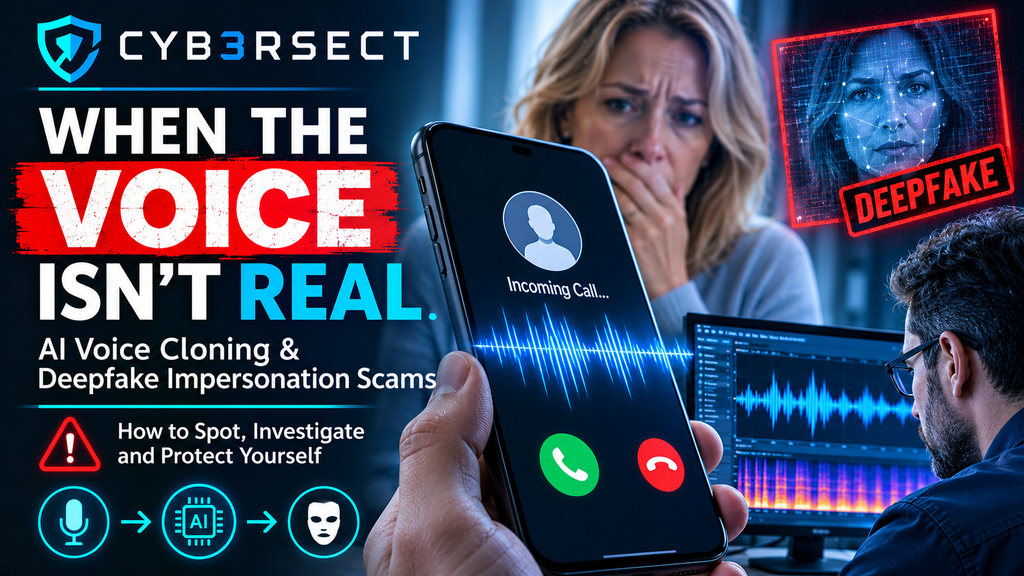
When the Voice Isn’t Real: How to Investigate AI Voice-Cloning and Deepfake Impersonation Scams
A phone call arrives from someone who sounds exactly like your son, daughter, business partner, manager or financial adviser. They are distressed. There is an emergency, an urgent payment, a confidential business problem or an opportunity that cannot wait.
The voice sounds familiar. The caller knows personal details. They may even send a convincing video or voice message to support their story.
But what if the person speaking is not who you think it is?
Artificial intelligence has made it possible to generate convincing imitations of human voices and create manipulated audio and video. Criminals can use these technologies to make impersonation scams more believable, particularly when combined with stolen personal information, compromised accounts and social engineering.
The danger is not limited to fake emergency calls. AI-generated voices and deepfake media can be used in investment fraud, business impersonation, executive fraud, identity theft and attempts to obtain access to sensitive accounts.
For individuals and organisations, the challenge is no longer simply identifying suspicious messages. It is establishing whether the person communicating is genuine and preserving the digital evidence needed to investigate what happened.
How AI Voice-Cloning Scams Work
Voice cloning uses artificial intelligence to generate speech that resembles a particular person’s voice. Depending on the technology and the available audio, an imitation may reproduce characteristics such as tone, accent, rhythm and pronunciation.
Criminals may obtain voice samples from publicly available videos, social media posts, interviews, online meetings or recordings shared privately. They can then use the imitation in calls, voice messages or other communications.
A typical scheme may follow several stages.
1. Collecting information about the target
The criminal researches the person or organisation being impersonated. Public profiles, company websites, social media posts and previous data exposures can provide names, relationships, job titles and communication habits.
2. Creating or obtaining an imitation
The criminal uses an AI voice-generation tool or manipulated recording to imitate a known person. In some cases, the voice may be combined with a fabricated profile, message history or video.
3. Establishing trust
The impersonator contacts the target using a familiar name, number, account or communication channel. Caller ID information can also be manipulated, so a familiar display name should not be treated as proof of identity.
4. Creating urgency
The caller may claim that a relative has been arrested, an employee needs immediate assistance, a supplier’s bank details have changed or an executive has authorised an urgent payment.
5. Requesting money, information or access
The final objective may be a bank transfer, cryptocurrency payment, password, verification code, confidential document or remote access to a device.
The combination of a familiar voice and an urgent request can make it difficult for someone to pause and independently verify the situation.
The Most Common Situations Involving AI Impersonation
AI-generated audio can support several types of fraud. Understanding the context can help identify what evidence should be collected.
Fake emergency calls from family members
A caller may sound like a relative and claim to be in immediate danger. They might say they have been arrested, injured or stranded and need money urgently.
The caller may insist that the situation is confidential or that there is no time to contact anyone else. These demands are warning signs, even when the voice sounds familiar.
Executive impersonation and payment fraud
In a business environment, an employee may receive a call or voice message that appears to come from a senior manager. The caller may request an urgent transfer, changes to supplier payment details or access to confidential information.
This can overlap with business email compromise and payment-diversion fraud. A voice call should never replace an established payment approval process.
Cyb3rsect’s guide to investigating business email compromise and payment diversion provides related guidance on examining suspicious business communications.
Fake investment endorsements
Deepfake videos and cloned voices can make it appear that a public figure, financial professional or company executive is promoting an investment opportunity.
A convincing video does not establish that the person endorsed the product or that the investment business is genuine. The identity of the speaker, the origin of the media and the legitimacy of the organisation must be examined separately.
Impersonation of banks and government officials
A scammer may pretend to represent a bank, regulator, police department or government agency. The caller may claim that an account is compromised or that immediate action is required to protect funds.
The FBI has specifically warned about criminals using AI-generated videos and impersonation tactics to make fraudulent communications appear official.
Warning Signs That a Call or Voice Message May Be Fake
There is no single visual or audio clue that reliably identifies every AI-generated recording. Some synthetic media may be convincing, while genuine recordings can also sound unusual because of poor connections or background noise.
Instead of relying on one supposed deepfake detector, look at the entire communication.
Warning signs include:
- An urgent request to transfer money or cryptocurrency.
- Instructions to keep the conversation secret.
- A request to bypass normal payment or identity-verification procedures.
- A sudden change in bank details or payment destination.
- A caller who refuses to let you independently contact the person they claim to represent.
- A request for passwords, authentication codes or remote access.
- A new messaging account that claims to belong to someone you already know.
- Inconsistencies between the caller’s story and independently verified information.
The most important principle is simple: a familiar voice is not sufficient proof of identity.
If a relative or colleague requests money unexpectedly, end the conversation and contact them through a previously trusted number or communication channel. A family verification phrase can also help, provided it has not been shared publicly.
How to Investigate a Suspected AI Voice-Cloning Scam
If an individual or organisation believes a cloned voice or manipulated recording has been used, the investigation should establish what happened, which communications were involved and whether other accounts or systems were compromised.
1. Preserve the original audio and messages
Save the original voice message, audio file, video, email, text message or messaging-platform conversation.
Where possible, preserve the original file rather than relying on a recording made by playing it through another device. Re-recording, editing, converting or repeatedly forwarding media can alter its technical characteristics.
Record when and where the communication was received, which account or number delivered it and what the sender requested.
For additional guidance, see Cyb3rsect’s article on preserving digital evidence for cybercrime and fraud investigations.
2. Examine the communication source
Investigators should establish how the communication reached the target.
Relevant information may include:
- Telephone numbers and call records.
- Messaging account identifiers.
- Email addresses and full email headers.
- Website addresses and account profiles.
- Timestamps and communication history.
- Attachments and links.
- Any changes to contact details during the conversation.
Caller ID and display names can be spoofed. They should be treated as investigative leads, not conclusive proof of who placed a call.
3. Review the audio and video files
Where suitable original files are available, a forensic examination may consider file properties, metadata, encoding information, audio characteristics and signs of editing or processing.
An analyst may also compare recordings with lawfully obtained reference material, where appropriate and technically feasible.
However, it is important to understand the limitations. A single AI-detection tool cannot conclusively establish that a recording is synthetic. Compression, background noise, phone networks and ordinary editing can affect audio characteristics.
A responsible assessment should explain the methods used, the limitations encountered and the degree of confidence supported by the available evidence.
4. Investigate associated accounts and devices
Voice impersonation may be only one part of a larger fraud attempt.
Investigators may need to examine whether the target’s email, social media, messaging or business accounts were accessed without authorisation.
Relevant questions include:
- Was the person’s account compromised?
- Were private recordings or personal information accessed?
- Did an attacker impersonate the individual through an existing account?
- Were suspicious login sessions or account changes recorded?
- Did the target receive phishing links or malicious attachments?
- Was remote access software installed?
Where appropriate, email forensics and cloud-account analysis can help establish whether the impersonation was connected to a wider compromise.
5. Trace the financial and communication timeline
If a payment was made, preserve the transaction information immediately.
This may include bank transfer confirmations, recipient details, cryptocurrency transaction identifiers, wallet addresses, exchange information and correspondence about the payment.
Build a chronological record showing when the first contact occurred, when the request was made, what instructions were provided and when any payment or account change took place.
The purpose is to connect the communications with the subsequent actions without assuming that every event was carried out by the same person.
6. Document findings carefully
A useful investigation report should distinguish between verified facts, technical observations, reported statements and unresolved questions.
It should explain the evidence examined, the methods applied, relevant timestamps, findings and limitations.
Where the available evidence cannot establish who created a recording or placed a call, the report should say so. Identifying a synthetic voice is not the same as identifying the person responsible.
What to Do Immediately If You Receive a Suspected Deepfake Call
If someone contacts you using a familiar voice and asks for urgent money or sensitive information, take these steps:
- Do not transfer money or disclose passwords, authentication codes or financial details.
- End the call and independently contact the person through a trusted number.
- Contact another family member or colleague if the caller claims there is an emergency.
- Preserve the call details, original messages, recordings and related correspondence.
- Do not delete suspicious messages or reset devices before considering whether relevant evidence needs to be preserved.
- If financial information or account credentials were exposed, contact the relevant bank or service provider through its official channel.
- Report suspected fraud to the appropriate law-enforcement or consumer-protection authority.
If a business payment may have been diverted, notify the finance team and relevant bank immediately. The speed of notification can matter when a transfer is being investigated.
Why Digital Evidence Matters in AI Impersonation Investigations
AI-generated media creates a difficult problem for victims: a recording may sound genuine, but the apparent speaker may have had no involvement in the communication.
A proper investigation therefore needs to look beyond whether a voice sounds real.
The source of the recording, the method of delivery, account activity, device evidence, communication history and financial records may all contribute to understanding the incident.
Preserving evidence early is particularly important. Messages may disappear, accounts may be deleted, platform records may become unavailable and devices may be altered after the incident.
Cyb3rsect’s digital forensic reporting guide explains why a structured report should document the evidence examined, investigative methods, findings and limitations.
How Cyb3rsect Approaches Digital Impersonation and Fraud Investigations
When a suspected impersonation incident involves digital communications, the priority is to understand the available evidence and establish a clear investigative timeline.
Depending on the circumstances, a digital investigation may involve reviewing preserved audio and video files, examining email and messaging records, analysing relevant account activity, documenting suspicious contact details and organising transaction-related evidence.
The appropriate scope depends on the evidence available, the systems involved, the authority to access them and the questions the investigation is intended to answer.
Cyb3rsect focuses on digital forensics, cyber investigations and online fraud intelligence. The objective is to help individuals and organisations better understand suspicious digital activity through structured evidence examination and clear reporting.
No responsible investigator should promise that every synthetic recording can be conclusively identified or that a perpetrator can always be traced. Findings must be based on evidence, not assumptions.
Final Thoughts: Never Trust a Voice Without Verifying the Person Behind It
AI voice cloning has changed the way impersonation scams can be carried out. A familiar voice, convincing video or apparently authentic message can no longer be treated as reliable proof of identity.
The most effective response combines independent verification, strong payment controls, careful account security and early evidence preservation.
If you suspect that someone has used an AI-generated voice or manipulated video to impersonate you, a family member or a colleague, preserve the original communications and document what happened before important evidence is lost.
For assistance with understanding suspicious communications, preserving digital evidence or assessing a suspected online fraud incident, visit Cyb3rsect and submit an enquiry describing the circumstances.
