

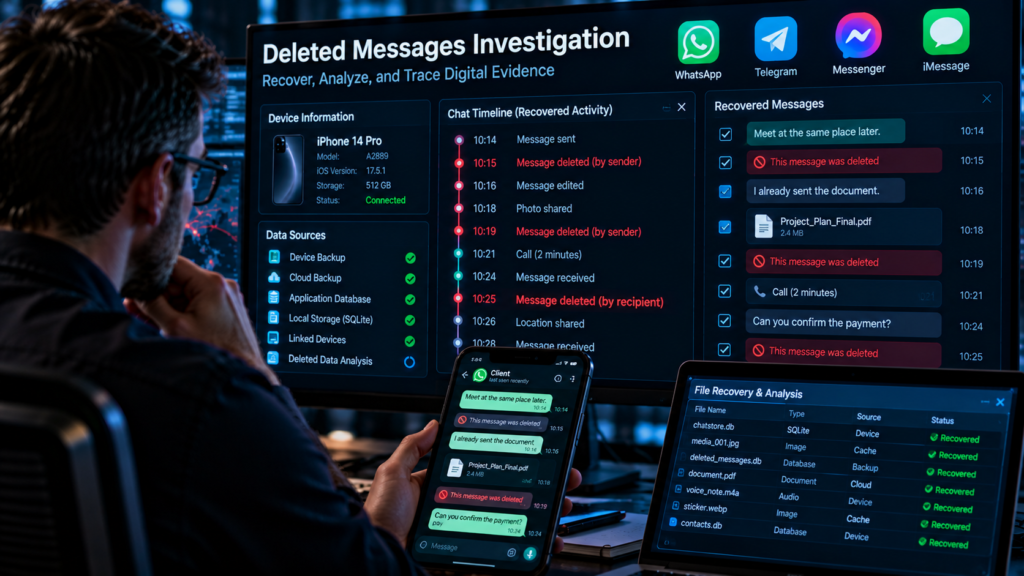
They Deleted the Messages. What Evidence Is Still Left? A Digital Forensics Guide to WhatsApp, Telegram, and Messenger
The conversation existed yesterday. Today, the messages are gone. But does deleting a chat really erase everything?
At 10:14 p.m., a business owner receives a message from a supplier requesting a change to payment instructions.
The message includes new bank details.
The business owner questions the request.
A few minutes later, the message disappears.
The supplier claims no such instruction was sent.
The following morning, the business owner discovers that an employee had already initiated a payment using the disputed details.
The original message could be important evidence.
But it is no longer visible in the conversation.
Was the message deleted only from the sender’s device?
Was it removed from both sides of the chat?
Does a notification still exist?
Was the conversation included in a backup?
Could another participant have retained a copy?
And can investigators determine whether the message existed without recovering its original text?
This hypothetical scenario illustrates an increasingly common digital evidence problem.
Messaging applications make communication fast, convenient, and sometimes temporary.
Messages can be deleted, edited, automatically removed, or made inaccessible when accounts and devices change.
But the disappearance of a message from a conversation does not necessarily establish that every associated record has been erased.
At Cyb3rsect, our digital investigation content examines electronic evidence, messaging records, mobile devices, and the challenges involved in reconstructing disputed communications.
This guide explains what deleted-message recovery can realistically involve, what evidence may remain, and how individuals and organizations can preserve information before it disappears.
Deleted From the Screen Does Not Always Mean Deleted Everywhere
A messaging application displays information stored or synchronized through one or more systems.
Depending on the application, a conversation may involve local device storage, cloud synchronization, backups, other participants’ devices, and linked desktop sessions.
When a user deletes a message, the application performs a defined action.
That action may remove the message from the current conversation view.
It may also remove content from other synchronized devices.
But the exact effect depends on the application, the deletion option, and its technical design.
For example, deleting a message only for yourself is different from using an option intended to remove it for everyone.
Investigators should establish which deletion behavior applies before making claims about recoverability.
The Five Questions That Determine Whether Recovery Is Possible
Before attempting to recover a deleted conversation, an investigator needs to know:
- Which application was used? WhatsApp, Telegram, Messenger, and other platforms have different storage and synchronization models.
- Which device was involved? The operating system, device condition, and security settings affect available evidence.
- How was the message deleted? Local deletion, deletion for everyone, disappearing messages, and account removal are different events.
- When did deletion occur? Relevant backups, notifications, and retained records may change over time.
- What lawful evidence sources are available? An authorized device, an existing backup, a recipient’s copy, or a business archive may contain relevant information.
Without these details, promises of guaranteed recovery are unreliable.
WhatsApp: What Happens When Someone Deletes a Message?
WhatsApp uses end-to-end encryption for personal messages and calls.
Its deletion features allow users to remove messages from their own conversation and, within applicable limits, request deletion for everyone.
However, the technical consequences of deletion can vary.
A message may have been seen before deletion.
A recipient may have saved information separately.
Relevant media might have been stored outside the chat under certain circumstances.
An existing backup may contain an earlier state of the conversation, depending on when it was created and what it includes.
None of these possibilities guarantees that the deleted message can be reconstructed.
Importantly, end-to-end encryption means investigators should not assume that WhatsApp can simply provide readable copies of ordinary private message content on request.
A realistic investigation focuses on available authorized evidence sources.
Can a WhatsApp Backup Restore Deleted Messages?
Sometimes an existing backup may contain messages that are no longer present in the current conversation.
But the backup must actually include the relevant data.
Its creation date matters.
Its encryption and account requirements matter.
And restoring a backup can affect the current state of the application.
A backup made after deletion may no longer contain the missing message.
A backup made before deletion may be useful, but recovery still depends on the application and available credentials.
Forensic preservation should come before unnecessary restoration attempts.
An investigator may first document the current device and available backup information to avoid accidentally replacing useful evidence.
Telegram: Why the Type of Chat Matters
Telegram does not use the same storage model for every conversation.
Its ordinary cloud chats differ from Secret Chats.
Cloud chats are designed to synchronize through Telegram’s service across supported devices.
Secret Chats use end-to-end encryption and are associated with the participating devices rather than Telegram’s ordinary cloud-chat synchronization.
Deletion behavior also differs according to chat type and application functionality.
In some circumstances, a Telegram message can be removed from both participants’ conversation histories.
That can significantly limit recovery opportunities.
A forensic investigation must therefore establish whether the disputed communication was a cloud chat or a Secret Chat.
It should not assume that Telegram maintains an accessible historical archive of messages that users have deleted.
Facebook Messenger: Deleted, Uns sent, or Archived?
Messenger includes features for removing messages, unsending content, and archiving conversations.
These actions should not be confused.
An archived conversation is generally hidden from the main chat list rather than necessarily deleted.
An unsent message may no longer be visible to other participants.
A locally removed conversation may have different consequences from a message removed for everyone.
Messenger also supports end-to-end encrypted personal conversations, with storage and recovery behavior depending on the relevant features and settings.
Investigators should examine the exact action involved and the evidence available from authorized accounts or devices.
The presence of an empty conversation does not establish that the platform can restore its former contents.
What Evidence Might Survive After a Message Is Deleted?
Even when the original text cannot be recovered, related evidence may exist.
Potential sources include:
| Evidence source | What it might establish |
|---|---|
| Existing device backups | An earlier state of a conversation, if retained |
| Other participants’ devices | Copies of messages or related media still available |
| Notification records | Limited details about a received message, if retained |
| Saved attachments | Media or documents stored separately from the chat |
| Linked devices | Relevant synchronized content or application records |
| Screenshots | A visual record of what appeared on screen |
| Business archives | Communications retained through authorized organizational systems |
| Related emails or payment records | Context surrounding a disputed instruction |
The availability of these records varies considerably.
A notification might show only the sender’s name.
A screenshot might lack sufficient context.
A backup might be encrypted or inaccessible.
The existence of a potential evidence source is not proof that useful content can be recovered from it.
The Screenshot Problem: Can a Screenshot Prove What Someone Said?
Screenshots can be useful evidence.
They may preserve message text, timestamps, names, and parts of a conversation.
But screenshots can also be edited or presented without context.
An investigator may examine the original image file, available metadata, surrounding communications, and other independent records.
A screenshot alone may not establish that a message was genuinely sent through the claimed account.
Where possible, corroboration strengthens the finding.
For example, a screenshot of a payment instruction may be compared with transaction records, relevant emails, and the recipient’s account activity.
The objective is to establish a supported sequence of events.
Can Investigators Recover Messages From a Phone’s Storage?
In some cases, forensic examination of an authorized device may identify relevant application records, databases, media, or other artifacts.
However, modern mobile devices use security features that can make deleted data difficult or impossible to recover.
Encryption, storage management, application behavior, and data overwriting all affect the result.
Older assumptions about recovering deleted files directly from storage do not necessarily apply to current smartphones.
A forensic tool may extract existing application data without being able to reconstruct messages that have been securely removed.
Claims that a particular tool can recover every deleted WhatsApp or Telegram message should be treated skeptically.
Why the First Recovery Attempt Can Make Things Worse
Someone trying to recover a missing conversation may install multiple applications, reset their phone, restore an old backup, or repeatedly reinstall the messaging app.
These actions can change the device’s state.
They may overwrite current information, remove application records, or complicate the evidence timeline.
If the conversation is important to a fraud, workplace, or legal investigation, preservation should take priority.
Avoid unnecessary changes to the device.
Document the relevant account and application details.
Preserve existing records through lawful and appropriate procedures.
For a more detailed explanation, see Cyb3rsect’s Digital Evidence Preservation guide.
The Message Was Deleted for Everyone. Is the Case Over?
Not necessarily.
A deleted message may still have left evidence of the surrounding interaction.
For example, a business might possess a payment record corresponding to the disputed instructions.
A recipient may have preserved a screenshot before deletion.
Another participant may have retained the relevant attachment.
A separate email could reference the same transaction.
These records may help establish what happened even when the original message text is unavailable.
But investigators must avoid treating circumstantial evidence as direct proof of the missing content.
A payment to a particular bank account does not, by itself, establish the exact words of a deleted message.
What About Disappearing Messages?
Some messaging applications support messages that disappear after a defined period.
These features are designed to reduce how long content remains available within the application.
The exact behavior depends on the platform and settings.
Disappearing messages may leave fewer recoverable records than ordinary retained conversations.
However, participants may still have seen, recorded, or separately saved information before it disappeared.
An investigation should distinguish between the application’s intended deletion behavior and any independently preserved evidence.
A disappearing-message setting is not proof that no evidence exists anywhere.
Equally, it is not a guarantee that investigators can recover the original content.
Can Deleted Messages Be Recovered From Someone Else’s Phone?
Another participant may still possess relevant information.
But access must be lawful and authorized.
A person should not attempt to enter another individual’s account or device without permission.
In a workplace or legal investigation,
