

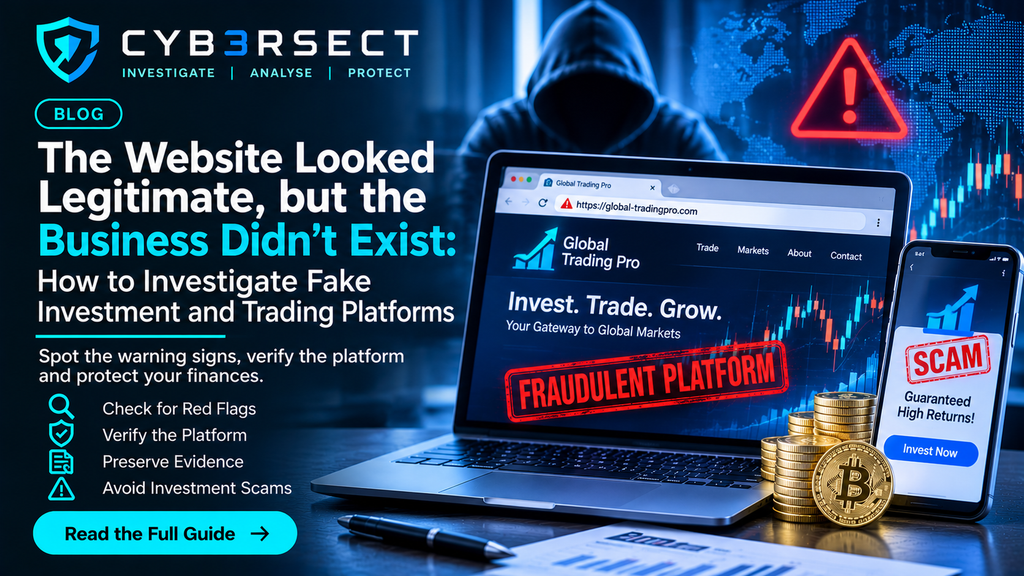
The Website Looked Legitimate, but the Business Didn’t Exist: How to Investigate Fake Investment and Trading Platforms
A trading platform can look convincing. It may display professional charts, account balances, market prices, customer testimonials and an impressive company profile. Someone posing as an account manager may explain how to deposit funds, monitor returns and request withdrawals.
But a polished website is not proof that a legitimate investment business exists.
Fraudulent investment operations can use cloned websites, fabricated company details, misleading regulatory claims and fake trading dashboards to persuade people to transfer money. Some may even allow small withdrawals initially to build confidence before demanding additional deposits or preventing access to funds.
The challenge for someone who suspects fraud is separating what the platform claims from what can actually be verified.
This guide explains how to investigate suspicious investment and trading platforms, examine the digital evidence, check company and regulatory information, and document warning signs without jumping to unsupported conclusions.
Why Fake Investment Platforms Can Look So Convincing
Modern fraudulent platforms can imitate the appearance of established financial services.
A website may contain:
- A professional company logo and corporate design.
- Trading charts and market dashboards.
- Cryptocurrency and foreign exchange prices.
- Account balances and transaction histories.
- Customer support chat functions.
- Fabricated testimonials.
- Company registration details.
- Names of supposed executives or investment advisers.
- Claims of regulatory authorisation.
- Promises of unusually high or consistent returns.
Some websites display account balances that appear to increase as the customer deposits more money. However, a number displayed on a dashboard does not establish that the funds exist, that trades have occurred or that the customer can withdraw the balance.
A platform must be assessed through independent evidence, not simply its own presentation.
Warning Signs That an Investment Platform May Be Fraudulent
No single warning sign proves that a platform is fraudulent. However, several indicators together can justify a more detailed investigation.
1. Guaranteed or unusually consistent returns
Be cautious when a platform promises guaranteed profits, unusually high returns or minimal risk.
Genuine investments involve risk. Claims that profits are certain, regardless of market conditions, should be examined carefully.
2. Pressure to deposit quickly
An account manager may claim that an opportunity is limited, a market event is imminent or an account must be upgraded immediately.
Pressure to make a financial decision without independent verification is a significant warning sign.
3. Unclear company ownership
The website may provide a company name but no independently verifiable operating address, management information or corporate relationship.
A registered company name alone does not establish that the company operates the website or provides the advertised financial service.
4. Unverifiable regulatory claims
A platform may display a regulator’s logo, licence number or registration certificate.
These details should be checked directly against the regulator’s official records. A real licence number may be copied from an unrelated authorised business.
5. Withdrawal restrictions
A customer may be told that withdrawals require additional deposits, tax payments, verification charges or account upgrades.
A demand for further payment before releasing funds deserves particular scrutiny. Do not assume that a payment request is legitimate simply because it appears inside the platform.
6. Communication through unofficial channels
The supposed adviser may rely on messaging applications, personal email addresses or telephone numbers that cannot be independently connected to the claimed business.
7. Changing company or website details
The platform may change its domain, company name, support contact information or payment instructions without a clear explanation.
Document these changes because they may be relevant to understanding the operation.
Step 1: Preserve the Website Before It Changes
If a platform is suspected of being fraudulent, preserve what is visible before the website is modified, restricted or taken offline.
Start by recording:
- The complete website address.
- The date and time of access.
- The homepage and relevant service pages.
- Company and regulatory claims.
- Contact information.
- Terms and conditions.
- Privacy notices.
- Deposit and withdrawal instructions.
- Account dashboard screens, where lawfully accessible.
- Links to associated websites and applications.
Take screenshots that include the browser address bar where practical. A screenshot of a trading dashboard without its URL or surrounding context may be difficult to interpret later.
If the website redirects to another domain, record the sequence of addresses. Do not enter passwords, authentication codes or additional payment information simply to collect evidence.
Avoid interacting with suspicious downloads or applications on a normal work device.
Step 2: Verify the Company Behind the Platform
A platform may claim to be operated by a registered company. The next step is to establish whether the claimed business details can be independently verified.
Record the company name, registration number, registered address, incorporation date and any named directors or officers shown on the website.
Then compare these details with the relevant official company registry.
Consider:
- Does the company actually exist?
- Does the registration number match the stated name?
- Is the registered address consistent?
- Are the named officers supported by public records?
- Does the company claim to operate in a different jurisdiction?
- Is there evidence connecting the registered company to the website?
- Does the company appear to have any relationship with the financial services being advertised?
A genuine company registration does not automatically mean that an investment platform is authorised or that the registered company controls the website.
Fraudulent operators can copy details from legitimate businesses. A company may also be impersonated without its knowledge.
The investigation must distinguish between a company that exists and a company that has been independently connected to the platform.
Step 3: Check Regulatory Authorisation Independently
If a platform claims to provide investment, brokerage, trading or financial services, check the relevant financial regulator’s official records.
The appropriate regulator depends on the jurisdiction and the type of service being offered.
For example, in the United States, relevant public resources may include:
- The Securities and Exchange Commission (SEC).
- The Financial Industry Regulatory Authority (FINRA).
- The Commodity Futures Trading Commission (CFTC).
- State securities regulators.
In the United Kingdom, the Financial Conduct Authority (FCA) maintains public information about authorised firms and warnings.
In Australia, the Australian Securities and Investments Commission (ASIC) provides information about financial services licensing and investor warnings.
Use the regulator’s official website rather than a link supplied by the platform.
Check whether:
- The exact legal entity is listed.
- The licence or registration number matches.
- The authorised activities cover the advertised service.
- The website domain matches the regulator’s recorded details.
- The contact information is consistent.
- The authorisation is current and applicable to the relevant jurisdiction.
A platform may copy the identity of a legitimate authorised firm. This is sometimes described as a clone-firm or impersonation risk.
A matching company name or licence number is not enough. Verify the actual website and contact details against the regulator’s records.
Step 4: Investigate the Website Domain and Technical Details
The domain can provide useful investigative context.
Record the exact domain and any associated subdomains. Look for spelling variations, unusual extensions, extra words or domains that resemble an established financial business.
Where appropriate, publicly available technical checks may include:
- Domain registration information.
- Domain creation and update dates.
- DNS records.
- Nameservers.
- Certificate information.
- Hosting details.
- Website redirects.
- Historical website observations.
- Related domains and online references.
These details can help build a timeline and identify possible technical relationships.
However, domain privacy services are common, hosting may be shared and technical infrastructure can change. A shared IP address or nameserver does not establish common ownership.
Likewise, a recently registered domain is a risk indicator in context, not proof of fraud on its own.
Step 5: Examine the Trading Dashboard and Account Activity
A fraudulent platform may display an account balance, profit figure or transaction history that cannot be independently verified.
Preserve the account information available to the customer.
Relevant material may include:
- Initial deposit records.
- Account balance history.
- Displayed trades.
- Profit and loss statements.
- Deposit confirmations.
- Withdrawal requests.
- Withdrawal status messages.
- Account restrictions.
- Messages from account managers.
- Changes to account access.
Compare displayed activity with independent records.
For example, if the platform claims that a trade was executed, determine whether there is an independent transaction record or confirmation from the relevant exchange, broker or financial institution.
A dashboard screenshot can establish what the customer was shown at a particular time. It does not, by itself, prove that a real trade took place.
Step 6: Follow the Payment Trail
Payment records may help establish where funds were sent and which payment channels were used.
Collect:
- Bank transfer confirmations.
- Card transaction records.
- Cryptocurrency transaction IDs.
- Wallet addresses.
- Exchange deposit records.
- Payment processor receipts.
- Beneficiary information.
- Dates, amounts and references.
- Communications requesting each payment.
For cryptocurrency transactions, a blockchain transaction ID can help establish that a transfer occurred on a particular network. It does not automatically identify the person controlling the receiving wallet or prove what happened after the funds arrived.
If a bank transfer or card payment is involved, contact the financial institution promptly and report suspected fraud.
Do not send further money to a platform simply because an account manager claims that another payment is required to unlock a withdrawal.
Step 7: Preserve Conversations With Account Managers
Communication records can be important in understanding how the customer was introduced to the platform and persuaded to deposit funds.
Preserve original messages and relevant attachments from email, messaging applications, social media and other communication channels.
Record:
- The account manager’s displayed name.
- Usernames and profile links.
- Email addresses and telephone numbers.
- Dates and times of conversations.
- Investment representations.
- Deposit instructions.
- Withdrawal promises.
- Requests for additional payments.
- Claims about company registration or regulation.
- Any changes in contact details.
Avoid editing or selectively deleting messages. Preserve the conversation context, including earlier discussions that may explain how trust was established.
If a telephone conversation is relevant, create a contemporaneous written note describing the date, participants and substance of the discussion. Follow applicable laws before recording calls.
Step 8: Investigate Withdrawal Problems and Additional Payment Demands
A customer may initially see a balance that appears profitable, only to encounter difficulties when requesting a withdrawal.
Common explanations given by suspicious operators may include:
- A tax payment is required before withdrawal.
- An account must be upgraded.
- A verification deposit is needed.
- A release or processing fee must be paid.
- A compliance department has temporarily blocked the account.
- A further deposit is required to meet a minimum balance.
Do not treat these explanations as verified facts.
Preserve the exact wording of each request, the payment instructions and any deadlines imposed. Record whether the platform’s explanation changes over time.
If the platform claims that a tax or regulatory payment is required, independently verify the claim with the relevant authority or a qualified professional. Do not rely solely on the platform’s own explanation.
Step 9: Watch for Secondary Recovery Scams
People who have already lost money may become targets for another fraudulent operation.
A supposed recovery specialist may claim to have located the funds, identified the operator or obtained access to a wallet. They may then demand an upfront payment, tax, release fee or wallet connection.
Be cautious of:
- Guaranteed recovery promises.
- Claims of privileged access to banks or exchanges.
- Requests for seed phrases or private keys.
- Unsolicited messages offering to recover funds.
- Pressure to pay before receiving a clear written scope.
- Requests to install remote access software.
- Claims that funds are already secured but cannot be released without another payment.
A genuine investigation should explain its proposed methods, authority, scope, costs and limitations.
For more guidance, see Cyb3rsect’s article on fake crypto recovery companies.
Step 10: Build a Clear Evidence Timeline
Once the main records have been collected, organise them chronologically.
A useful timeline may include:
- First contact with the platform.
- Initial website visit.
- Account creation.
- First deposit.
- Communications with account managers.
- Displayed trading activity.
- Subsequent deposits.
- First withdrawal request.
- Any additional payment demands.
- Account restrictions or communication changes.
- Reports to banks, exchanges or authorities.
For each event, identify the source of the information. Distinguish bank records from customer recollections, platform screenshots and independently verified technical observations.
A clear timeline can help reveal inconsistencies and support a more focused investigation.
Can the People Behind a Fake Trading Platform Be Identified?
Sometimes evidence can establish links between domains, communications, payment destinations, accounts and technical infrastructure.
However, identifying the individual or organisation responsible is not always possible from publicly available information.
Operators may use false identities, compromised accounts, privacy services, intermediaries or infrastructure in multiple jurisdictions.
Some relevant information is held by banks, exchanges, hosting companies, domain registrars and other service providers. Access to certain records may require formal legal processes.
A responsible investigation should separate:
- What has been directly observed.
- What has been independently verified.
- What technical evidence suggests.
- What remains an inference.
- What additional information may be required.
A wallet address, IP address or company registration should not be presented as conclusive proof of a person’s identity.
How Cyb3rsect Can Help Investigate Suspicious Investment Platforms
When someone suspects that an investment platform is fraudulent, the challenge is often connecting the website, company claims, communications and payment records into a coherent picture.
Cyb3rsect focuses on digital investigations and evidence-led analysis. Depending on the agreed scope, lawful authority and available records, an investigation may involve:
- Reviewing suspicious investment websites and domains.
- Examining company and regulatory claims against available public information.
- Organising emails, messages and account records.
- Reviewing payment information and cryptocurrency transaction references.
- Building a timeline of deposits, communications and withdrawal requests.
- Documenting findings, limitations and recommended next steps.
The scope depends on the evidence available and the systems or records that can lawfully be accessed. No investigation should promise guaranteed identification of operators or recovery of transferred funds.
If you believe you have interacted with a suspicious investment or trading platform, visit Cyb3rsect to discuss the circumstances and available evidence.
What to Do If You Suspect an Investment Platform Is Fake
Do not make another deposit while the platform’s legitimacy is in question.
Preserve the website address, account information, original communications, payment records and transaction references. Contact your bank, card provider or cryptocurrency exchange through its official channels if funds have been transferred.
Verify company and regulatory claims independently. Report suspected fraud to the relevant authorities and be cautious of anyone offering guaranteed recovery.
A convincing website is not proof of a legitimate business. A displayed account balance is not proof that funds exist. And a company registration is not proof that the company operates or authorises the platform.
The strongest starting point is independent verification, careful evidence preservation and a clear record of what actually happened.
Cyb3rsect — Investigate. Analyse. Protect.
