

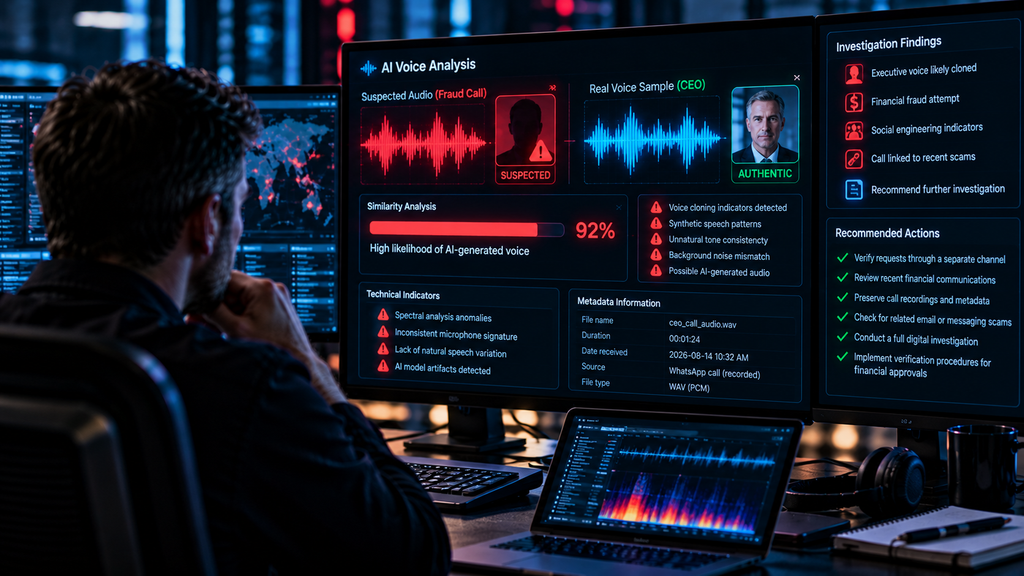
The Voice Was His. The Instructions Weren’t: How AI Voice Cloning Is Changing Corporate Fraud
The finance manager recognized the CEO’s voice immediately. The tone was familiar, the instructions were clear, and the request sounded urgent. There was only one problem: the CEO had never made the call.
At 4:18 p.m. on a Friday, a finance manager receives a phone call.
The caller sounds like the company’s chief executive.
He explains that a confidential acquisition requires an immediate payment to a new business account.
The transaction must be completed before the banks close.
The caller knows the company’s internal terminology. He references a recent meeting and speaks with the same distinctive rhythm the manager has heard for years.
When the finance manager asks whether the payment can wait until Monday, the response is immediate.
The deadline cannot move.
The caller also insists that the transaction remain confidential.
Everything sounds familiar.
But the request violates the company’s normal payment procedures.
The finance manager hesitates, ends the call, and contacts the CEO through a previously established internal number.
The CEO knows nothing about the payment.
The original caller was an impersonator.
Whether the impersonation involved AI-generated speech, a human imitator, edited recordings, or another technique remains an investigative question.
This fictional scenario illustrates a growing corporate security concern: voice-based impersonation supported by artificial intelligence and social engineering.
Modern speech synthesis can produce increasingly convincing voices. When combined with stolen business information, caller ID manipulation, and carefully timed requests, the resulting fraud attempts can be difficult to recognize by sound alone.
At Cyb3rsect, our cybersecurity investigation content explores digital impersonation, electronic evidence, corporate fraud, and the technical questions that arise when communications cannot be trusted at face value.
This article examines how AI voice cloning is used in fraud, what investigators can establish from suspicious recordings, and how organizations can protect themselves.
The New Weakness in Corporate Verification
For years, many employees have treated a familiar voice as a sign of authenticity.
A manager recognizes a colleague’s speech.
An accountant recognizes a director’s accent.
A customer service representative recognizes a regular client.
Voice familiarity can be useful in ordinary conversation.
But it should not serve as the sole authorization mechanism for financial transactions or sensitive administrative changes.
A voice may be imitated.
A recording may be replayed.
A call may be manipulated.
And synthetic speech may resemble a real person’s voice closely enough to deceive a listener.
The security problem is therefore broader than artificial intelligence.
It concerns an organization’s reliance on a communication channel that does not independently establish the speaker’s identity.
What Is AI Voice Cloning?
AI voice cloning involves using machine learning to generate speech that resembles a particular speaker.
Depending on the technology, a system may learn characteristics of a voice from reference recordings.
These characteristics can include pronunciation, pitch patterns, timing, and other acoustic qualities.
The resulting speech may be generated from text or produced through voice-conversion techniques.
The quality varies considerably.
Some outputs contain obvious artifacts.
Others can sound convincing, particularly over a telephone connection where audio quality is already limited.
Importantly, not every synthetic voice is used maliciously.
Voice generation has legitimate applications in accessibility, entertainment, localization, and communication.
The concern arises when the technology is used to impersonate someone without authorization or to deceive another person into taking action.
Where Would a Criminal Obtain a CEO’s Voice?
Executives often have publicly available recordings.
These may include interviews, conference presentations, webinars, company announcements, podcasts, and social media videos.
Such material can provide examples of how someone speaks.
In other cases, an impersonator may obtain audio through compromised communications, unauthorized recordings, or other sources.
However, investigators should not assume that a particular public video was used to create a synthetic voice simply because it was available online.
Establishing the actual source material may require evidence from the suspect’s systems or the service used to generate the audio.
In many cases, that information is unavailable.
The presence of a convincing imitation does not automatically reveal how it was created.
The Fraud Is Not Just in the Voice
An effective impersonation attempt often relies on several forms of deception at once.
The caller may know an employee’s role.
They may reference an actual supplier or project.
They may contact the employee during a busy period.
They may create urgency around a payment deadline.
They may discourage verification by invoking confidentiality.
The synthetic voice, if used, reinforces the deception.
But the surrounding social engineering may be just as important.
An attacker who knows a company’s approval process can tailor a request to exploit weaknesses in that process.
This is why a technical solution focused only on detecting artificial speech may not provide sufficient protection.
The Payment Request That Bypassed Every Warning Sign
Consider another fictional scenario.
A company requires two approvals for payments above a defined threshold.
An impersonator calls a department manager and claims to be the CEO.
The caller says a confidential transaction must be completed immediately.
The manager explains that a second approval is required.
The caller responds that the second approver has already agreed.
That statement is false.
The fraud attempt now depends on persuading the employee to accept an unverified claim rather than following the documented workflow.
The important security failure would not be the employee’s inability to recognize synthetic audio.
It would be allowing a phone conversation to override an independent approval requirement.
A well-designed control should remain effective even when the impersonation sounds convincing.
How AI Voice Fraud Differs From Traditional Business Email Compromise
Business email compromise commonly involves deceptive emails, compromised accounts, or fraudulent payment instructions.
Voice impersonation may involve telephone calls, voice messages, or conferencing platforms.
The two methods can also be combined.
For example, a fraudulent email might introduce a payment request.
A subsequent call from an apparent executive could be used to reinforce it.
Alternatively, an attacker might use a voice message to pressure an employee into changing account details.
Investigators should examine the entire communication sequence rather than treating the suspicious audio as an isolated event.
Relevant evidence may include emails, messaging records, call logs, payment instructions, and authentication activity.
For related investigative methods, see Cyb3rsect’s Email Forensics guide.
Can AI Voice Cloning Be Detected by Listening?
Sometimes synthetic audio contains audible inconsistencies.
These may involve unusual pauses, pronunciation problems, unnatural transitions, or other artifacts.
But these characteristics are not reliable proof on their own.
Ordinary recordings can also sound unnatural because of poor microphones, network compression, background noise, or audio editing.
And improved synthetic speech may contain fewer obvious artifacts.
A listener’s impression can provide a reason to investigate.
It should not be treated as a definitive forensic conclusion.
The same applies in reverse: a recording that sounds natural is not necessarily authentic.
What Audio Forensics Can Examine
A forensic examination may involve several technical areas.
File Structure and Metadata
Investigators may inspect the recording format, encoding details, timestamps, and available metadata.
These characteristics can help establish how a file was stored or processed.
However, metadata can be modified, omitted, or changed by legitimate applications.
Acoustic Characteristics
Specialists may examine speech patterns, frequency information, background sounds, and other audio features.
These findings require careful interpretation.
Recording Continuity
An examination may assess whether the recording contains abrupt changes, inconsistent background conditions, or signs of editing.
Source Comparison
Where appropriate reference recordings exist, analysts may compare characteristics of the questioned recording with known material.
Such comparisons are affected by recording quality, speaking conditions, and the methods used.
Communication Context
Call records, messaging history, device information, and surrounding business events may provide evidence that is more decisive than the audio alone.
A professional assessment should explain both the findings and their limitations.
Why an AI Detection Score Is Not Proof
Some automated systems attempt to classify audio as human-generated or synthetic.
Their outputs may be expressed as scores or probabilities.
These tools can be useful for screening or prioritizing investigation.
But a numerical result should not automatically be interpreted as a scientifically established probability that the recording is fake.
Detection performance depends on the model, the audio source, compression, language, background noise, and the types of synthetic speech represented in testing.
A tool that performs well under one set of conditions may be less reliable under another.
Investigators should consider validation, false-positive risks, and whether the tool is appropriate for the specific recording.
A defensible report should not declare a recording fraudulent solely because an automated detector produced a high score.
The First Question Investigators Should Ask
When an employee reports a suspicious executive call, the initial question is not necessarily:
“Was this generated by AI?”
A more useful question is:
“Was this communication authorized by the person it claimed to represent?”
That question can often be investigated through independent evidence.
Did the executive place the call?
Was the number or conferencing account associated with an authorized device?
Was the requested transaction approved through normal procedures?
Are there corresponding emails or calendar records?
Did the executive independently confirm the instruction?
Establishing that the real executive did not authorize the request may be sufficient to identify an impersonation attempt, even when the exact voice-generation method remains unknown.
The Digital Evidence Behind a Suspicious Call
An investigation may involve multiple sources.
| Evidence source | Potential investigative value |
|---|---|
| Original audio recording | Preserves the questioned speech for examination |
| Call records | Provides available timing and connection information |
| Messaging history | Establishes the surrounding communication sequence |
| Email records | Identifies related instructions or fraudulent correspondence |
| Payment records | Documents attempted or completed financial transactions |
| Account activity | May reveal compromise of communication platforms |
| Device records | Provides context about recording and communication applications |
| Internal approval records | Establishes whether the requested action was authorized |
Not every organization records calls.
Some services retain limited connection information.
And a displayed caller ID may not reliably establish the true origin of a call.
Investigators must work within the available evidence.
Why Preserving the Original Recording Matters
A suspicious audio file may be forwarded through several applications before it reaches an investigator.
Each transfer can affect the evidence.
Some messaging platforms compress or re-encode audio.
An employee may trim the recording to include only the suspicious statement.
A screen recording may capture sound differently from the original communication.
These changes can complicate technical examination.
Where lawful and available, investigators should preserve the original recording and associated context.
They should document how the file was obtained and retain relevant communication records.
For more information, see Cyb3rsect’s Digital Evidence Preservation guide.
Can a Phone Number Reveal the Impersonator?
A phone number can provide an investigative lead.
But it does not automatically identify the person responsible.
Caller ID information may be spoofed.
Numbers can be reassigned or used through communications services.
A call may also originate through systems that obscure the relationship between the displayed number and the person placing the call.
Investigators may need provider records, legal processes, or additional evidence to establish attribution.
A report should distinguish between a displayed number, an originating service, and an identified individual.
These are not interchangeable findings.
The Video Meeting That Added Another Layer of Deception
Voice impersonation can also intersect with manipulated video.
An attacker may attempt to impersonate an executive during an online meeting using synthetic audio, altered video, or a combination of techniques.
The use of a conferencing platform does not automatically make a communication authentic.
A meeting invitation can be deceptive.
A participant name can be misleading.
And a familiar-looking or familiar-sounding person may not be the individual they claim to be.
High-value decisions should therefore rely on independent verification and established authorization procedures.
This is particularly important for urgent requests involving payments, credentials, confidential information, or administrative access.
What Businesses Should Do After a Suspected AI Voice Scam
The response depends on whether the attempt was stopped or resulted in a completed action.
If No Payment Was Made
Preserve the suspicious communication.
Verify the claimed sender through a trusted channel.
Notify the appropriate security or fraud response personnel.
Review related messages and account activity.
Warn relevant employees about the specific impersonation attempt without circulating unnecessary personal information.
If a Payment Was Made
Contact the financial institution immediately using independently verified contact details.
Request urgent assistance with the suspected fraudulent transfer.
Preserve transaction records and related communications.
Report the incident to appropriate authorities.
Coordinate the investigation with relevant legal, finance, and security teams.
Recovery is time-sensitive and cannot be guaranteed.
If Credentials or Sensitive Information Were Disclosed
Assess which accounts or information may have been affected.
Restrict compromised access.
Review authentication and cloud activity.
Preserve relevant logs.
Determine whether further containment or notification is required.
The Most Effective Defense: Independent Verification
The strongest control against executive voice impersonation is not simply teaching employees to recognize synthetic speech.
It is making sure that a convincing voice cannot authorize a sensitive action by itself.
Organizations should establish procedures requiring employees to verify unusual or high-value requests through a trusted, independent channel.
For example, a finance employee who receives a telephone instruction to change bank details should verify it using a contact method already established in the company’s records.
They should not rely on a new number supplied during the suspicious conversation.
The verification process should be documented and consistently applied.
Six Corporate Controls That Reduce Voice Impersonation Risk
1. Independent payment approval. Require appropriate authorization for transfers and changes to beneficiary details.
2. Trusted callback procedures. Verify unusual requests using previously established contact information.
3. Separation of duties. Avoid allowing one person to initiate and approve high-risk transactions without independent oversight.
4. Clear escalation rules. Give employees a defined way to challenge urgent requests, including those apparently coming from senior executives.
5. Communication security. Protect executive email, messaging, and conferencing accounts against compromise.
6. Incident exercises. Test how finance, HR, and executive teams respond to convincing impersonation attempts.
These controls remain useful whether the impersonation involves AI, edited recordings, or an ordinary human fraudster.
Why a Secret Codeword Is Not a Complete Solution
Some organizations consider using a shared codeword to verify sensitive requests.
This can provide an additional check in limited circumstances.
But codewords can be disclosed, reused, overheard, or obtained through social engineering.
A codeword should not replace strong authentication or an independent approval process.
For high-risk transactions, verification should rely on established organizational controls rather than a single shared secret.
When an Executive’s Public Voice Becomes a Business Risk
Businesses should consider how publicly available executive recordings might be used in impersonation attempts.
That does not mean executives must stop giving interviews or speaking at conferences.
It means organizations should avoid assuming that a recognizable voice provides reliable proof of identity.
Communications policies should account for the possibility of impersonation.
Employees should be authorized to verify unusual requests even when the caller appears to be a senior leader.
A culture in which staff fear questioning executives can make social engineering more effective.
How Digital Forensics Supports Corporate Fraud Investigations
Digital forensics can help reconstruct the events surrounding a suspicious communication.
Investigators may examine the original audio, available metadata, related messages, authentication records, payment instructions, and other electronic evidence.
The objective is to establish what happened and which conclusions are supported.
Sometimes the evidence may demonstrate that an executive was impersonated.
Sometimes it may support a finding that a recording was edited or synthetic.
In other cases, the technical origin of the audio may remain uncertain.
That uncertainty should be documented rather than concealed.
For broader context, see Corporate Investigations: Digital Evidence, Employee Misconduct, and Cyber Incident Analysis.
What an AI Voice Fraud Investigation Report Should Include
A structured report may contain:
- The reported communication and alleged impersonation.
- The affected organization and relevant accounts.
- The original audio evidence and acquisition details.
- Available call and communication records.
- Relevant audio examination methods.
- Findings from independent identity verification.
- Related financial or administrative actions.
- Evidence of account compromise, where applicable.
- Technical limitations and unresolved questions.
- Recommendations for preventing recurrence.
Any use of automated synthetic-audio detection should be described accurately, including its limitations.
A report should not claim that a particular person created a deepfake unless sufficient evidence supports that attribution.
For guidance on reporting standards, see Digital Forensic Report: What a Professional Forensic Report Should Contain.
How Cyb3rsect Approaches AI-Enabled Impersonation Investigations
At Cyb3rsect, our investigative publications examine the relationship between suspicious digital communications, identity claims, and the evidence needed to evaluate potential fraud.
An authorized investigation may involve analyzing recordings, reviewing communication records, examining associated accounts, and reconstructing the sequence of events.
The goal is to distinguish confirmed impersonation from assumptions about how the audio was produced.
Not every unusual recording is AI-generated.
Not every convincing voice belongs to the person it resembles.
And no automated detector can guarantee accurate classification of every recording.
Organizations should prioritize evidence-based findings and effective verification procedures.
Businesses seeking information about corporate fraud, digital impersonation, and electronic evidence can explore Cyb3rsect.
Final Thoughts: Recognizing a Voice Is No Longer Enough
A familiar voice can make an instruction feel trustworthy.
But trust should not be confused with authorization.
AI-generated speech has made voice impersonation an increasingly important consideration for organizations handling financial transactions, confidential information, and sensitive administrative decisions.
The most resilient businesses will not depend on employees detecting every convincing imitation.
They will establish procedures that remain effective even when an attacker sounds exactly like someone the employee knows.
Digital forensics can help examine suspicious communications and document what the available evidence supports.
But prevention ultimately depends on stronger decision-making controls.
A voice can request a payment. It should never be the only thing that authorizes one.
For more information about digital investigations, cyber fraud, and evidence preservation, visit Cyb3rsect.
