

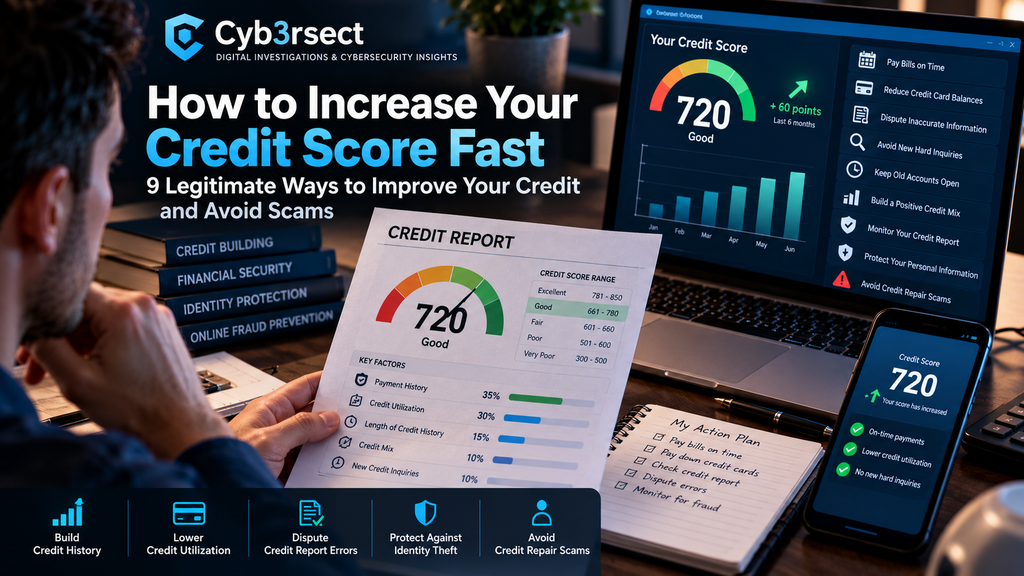
How to Increase Your Credit Score Fast: 9 Legitimate Ways to Improve Your Credit and Avoid Scams
Your credit score drops unexpectedly. A loan application gets rejected. Then an advertisement promises to raise your score by 150 points in seven days. Is that a real solution—or the beginning of another financial problem?
Imagine opening your banking app on a Monday morning and discovering that your credit score has fallen from 710 to 612.
You haven’t missed a payment recently. You haven’t applied for a new loan. Yet your score has changed significantly.
A few hours later, you search online for ways to increase your credit score quickly.
The results are overwhelming.
One website promises instant credit repair. Another claims it can erase negative records. A social media account offers to increase your credit limit by modifying your credit profile.
The promises sound appealing, especially if you’re trying to qualify for a mortgage, rent an apartment, or secure a better interest rate.
But there’s an important distinction between improving your credit legitimately and falling for someone who claims they can manipulate the system.
You can improve your credit score. Some improvements may appear relatively quickly. But there is no legitimate service that can guarantee a specific increase overnight.
At Cyb3rsect, our cybersecurity and digital investigation publications examine financial fraud, identity theft, account security, and the digital evidence behind suspicious financial activity.
This guide explains nine legitimate ways to improve your credit score, what actually influences the number, how long improvements may take, and how to avoid credit repair scams.
First, Understand What Determines Your Credit Score
Before trying to improve your credit score, understand what lenders and scoring models evaluate.
In the United States, FICO is one of the major credit scoring systems. Its five broad scoring categories are:
| Credit scoring factor | General FICO weighting |
|---|---|
| Payment history | 35% |
| Amounts owed | 30% |
| Length of credit history | 15% |
| New credit | 10% |
| Credit mix | 10% |
These are general category weights, not a formula that predicts exactly how many points an individual action will add. Different scoring models and individual credit profiles can produce different results.
Your income, bank account balance, and job title do not directly determine your FICO score.
Instead, credit scores primarily reflect information in your credit reports.
Understanding these factors helps you prioritize actions that can make a meaningful difference.
1. Pay Down Credit Card Balances to Reduce Utilization
Potential speed: After the lender reports a lower balance, often within a billing cycle or two.
One of the most practical ways to improve a credit score relatively quickly is to reduce high credit card balances.
Credit utilization measures how much of your available revolving credit you’re using.
For example:
- Total credit limit: $5,000
- Current balance: $4,000
- Credit utilization: 80%
If you reduce the balance to $1,000, your utilization falls to 20%.
That change may benefit your score once the updated balance is reported.
Many credit experts recommend keeping utilization below 30%, while lower utilization can be better for some credit profiles.
However, 30% is not a magic threshold that guarantees an increase.
Also consider utilization on individual cards, not just the total across all cards.
Practical tip: If you can afford to do so, paying down a balance before the issuer reports it may help a lower amount appear on your credit report sooner.
Do not sacrifice essential expenses or emergency savings solely to chase a particular score.
2. Check Your Credit Reports and Dispute Genuine Errors
Potential speed: After an investigation and any resulting correction are completed.
Sometimes the problem is not how you manage credit.
It is the information being reported about you.
Credit reports can contain inaccuracies, including:
- Accounts that do not belong to you.
- Incorrect late-payment records.
- Duplicate accounts.
- Wrong balances or credit limits.
- Incorrect account status.
- Fraudulent accounts opened through identity theft.
In the United States, you can obtain free credit reports through AnnualCreditReport.com, the federally authorized source.
Review your reports from Equifax, Experian, and TransUnion.
If you identify inaccurate information, dispute it with the relevant credit reporting company and the business that supplied the information.
Include supporting documents when available.
An investigation may result in the information being corrected, updated, or removed if it cannot be verified as reported.
Important: You cannot legitimately force the removal of accurate, current negative information simply because it hurts your score.
Be cautious of companies that encourage you to dispute every negative entry regardless of accuracy.
3. Pay Every Bill on Time and Prevent New Late Payments
Potential speed: Prevents additional damage immediately; meaningful improvement usually develops over time.
Payment history is the largest general category in FICO scoring.
A history of paying credit obligations on time helps demonstrate reliable repayment behavior.
If you have missed payments, getting current and staying current is an important step.
Consider setting up automatic minimum payments for credit cards and loans, provided your account has sufficient funds.
You can also use calendar reminders before payment deadlines.
If you’re experiencing financial difficulty, contact your lender before missing a payment.
Some lenders may offer hardship arrangements or other assistance.
These arrangements vary, and you should ask how they may be reported to credit bureaus.
One missed payment does not necessarily destroy your credit permanently, but preventing further delinquencies matters.
4. Ask for a Credit Limit Increase—Without Increasing Spending
Potential speed: Once a higher limit is approved and reported.
A higher credit limit may reduce utilization even when your balance remains unchanged.
Suppose your card has:
- Credit limit: $2,000
- Balance: $1,000
- Utilization: 50%
If the issuer raises the limit to $4,000 and your balance remains $1,000, utilization becomes 25%.
That may help your credit score.
But there are important cautions.
Some credit limit increase requests may involve a hard credit inquiry.
Approval is not guaranteed.
And increasing your limit only helps utilization if you avoid using the additional available credit to accumulate more debt.
Before requesting an increase, ask the card issuer whether it will involve a hard inquiry.
Never pay an unknown person who promises to manipulate your credit limit through unauthorized access.
5. Avoid Unnecessary Credit Applications
Potential speed: Helps prevent avoidable short-term score pressure; benefits accumulate with responsible account management.
Applying for several credit cards or loans in a short period can affect your credit profile.
A hard inquiry may have a small negative effect on your score.
Opening new accounts can also lower the average age of your credit history.
That doesn’t mean you should never apply for credit.
A new account may be useful when it serves a genuine financial purpose.
But applying repeatedly just to increase your score can backfire.
If you’re planning a major loan application, avoid opening unnecessary accounts immediately beforehand.
For certain types of loans, scoring models may treat qualifying rate-shopping inquiries within a specified window differently from unrelated applications.
Check the rules relevant to the scoring model and loan type.
6. Keep Older Credit Accounts Open When Appropriate
Potential speed: Primarily protects existing credit history and available limits rather than producing an immediate increase.
The age of your credit accounts can influence your score.
Older accounts may contribute to a longer credit history.
Closing a credit card can also reduce your available credit and potentially increase utilization.
For example, suppose you have two cards with a combined $10,000 limit and a $2,000 balance.
Your utilization is 20%.
If you close an unused card with a $5,000 limit, your remaining available limit may fall to $5,000.
Your utilization could rise to 40%.
However, keeping every card open is not always the right decision.
Annual fees, security concerns, or difficulty controlling spending may justify closing an account.
Make the decision based on your overall financial circumstances, not only your score.
7. Build Credit With a Secured Card or Other Legitimate Credit-Building Product
Potential speed: Usually several months or longer, especially if you’re establishing credit for the first time.
If you have limited credit history, a secured credit card may help you establish a record of responsible borrowing.
A secured card generally requires a refundable security deposit that helps determine the credit limit.
You use the card for purchases and make payments according to its terms.
Before applying, verify that the issuer reports account activity to major credit bureaus.
Look carefully at fees, interest rates, and deposit requirements.
A legitimate credit-building product should have clear terms and should not promise a guaranteed score increase.
You may also consider a credit-builder loan through an established financial institution, but evaluate the total costs and whether it genuinely fits your needs.
Do not take on unnecessary debt solely to improve your credit mix.
8. Address Collections and Past-Due Accounts Carefully
Potential speed: Varies substantially depending on the account and scoring model.
Past-due accounts and collections can affect credit scores.
But paying a collection does not automatically remove it from your credit report.
The impact of a paid collection also depends on the scoring model used.
Some newer models treat certain paid collections differently from older models.
Before paying an unfamiliar collection account, verify that the debt is legitimate and that the collector is authorized to collect it.
If the information is inaccurate, use the appropriate dispute process.
If the debt is valid, consider your financial options and the applicable legal rules.
Be especially careful with old debts because laws concerning collection and limitation periods vary by jurisdiction.
If you’re unsure how to proceed, a qualified nonprofit credit counselor or consumer attorney may help.
Avoid anyone who guarantees they can erase accurate collection records for a fee.
9. Protect Your Credit From Identity Theft and Fraudulent Accounts
Potential speed: Preventive protection is immediate; correcting fraudulent records can take time.
One of the most overlooked credit-improvement strategies is protecting the accuracy of your identity and credit information.
A criminal who obtains enough personal information may attempt to open credit accounts in your name.
You might discover the problem only after an unfamiliar inquiry, account, or unpaid balance appears on your report.
Signs of possible credit-related identity theft include:
- Credit inquiries you don’t recognize.
- New accounts you never opened.
- Bills from unfamiliar lenders.
- Unexpected collection notices.
- Changes to personal details on your credit report.
If you suspect identity theft, review your credit reports, contact the relevant institutions, and consider placing a credit freeze with each major bureau.
In the United States, credit freezes are free and generally prevent prospective creditors from accessing your credit report for new-credit decisions, subject to exceptions.
You can also report identity theft through IdentityTheft.gov.
A credit freeze does not directly raise your score, but it can help prevent further fraudulent credit activity.
This is where financial security and digital investigations intersect.
Cyb3rsect’s Email Forensics guide explains how suspicious communications can be examined, while our Digital Evidence Preservation guide discusses preserving electronic records that may be relevant to an investigation.
Which Credit Improvement Actions Can Work the Fastest?
Not every strategy operates on the same timeline.
| Action | When you might see an effect |
|---|---|
| Lower credit card utilization | After updated balances are reported |
| Correct a significant credit report error | After the correction reaches the report and is reflected in scoring |
| Obtain a higher credit limit | After approval and updated reporting |
| Pay bills consistently on time | Over months and longer |
| Avoid unnecessary new applications | Helps avoid additional inquiries and account-age changes |
| Maintain older accounts | Longer-term benefit |
| Open a secured credit card | Generally several months or longer |
| Resolve legitimate collections | Varies by scoring model and account details |
| Freeze credit after identity theft | Protects against certain new-account fraud; no direct score increase |
There is no universal timetable or guaranteed number of points.
Your starting score, existing accounts, and the scoring model used all matter.
Can You Increase Your Credit Score by 100 Points in 30 Days?
It is possible for a score to change substantially in a short period under certain circumstances, such as when a major reporting error is corrected or unusually high credit card balances fall significantly.
But a 100-point increase in 30 days is not something anyone can responsibly promise.
A person with a thin credit file and a recently reported high balance may experience a different result from someone with multiple serious delinquencies.
Claims such as “guaranteed 100 points in seven days” should be treated as warning signs.
The legitimate goal is to improve the accuracy and strength of your credit profile—not chase an arbitrary number through risky shortcuts.
The Credit Repair Scam That Promises a New Financial Identity
Imagine finding a social media advertisement:
“Bad credit? We can replace your credit profile and give you a fresh start immediately.”
The advertiser claims to have special access to credit reporting systems.
They request an upfront payment and ask for your personal information.
They may offer a so-called credit privacy number or instruct you to use a different identification number on applications.
This is dangerous.
Using false identifying information to obtain credit can create serious legal consequences.
Some criminals also use these schemes to steal personal information or money.
The Federal Trade Commission warns consumers about credit repair businesses that demand illegal advance fees, misrepresent what they can do, or encourage false disputes and identity theft reports.
No legitimate company can lawfully guarantee the removal of accurate, up-to-date negative credit information.
Seven Warning Signs of a Credit Repair Scam
Watch for these behaviors:
- Guaranteed score increases. The company promises an exact number of points by a specific date.
- Claims of insider access. Someone says they can secretly modify credit bureau records.
- Illegal upfront payment demands. A credit repair organization demands payment before providing the promised services.
- Fake identity offers. The seller proposes a new credit identity or fabricated identification information.
- False disputes. You are encouraged to challenge information you know is accurate.
- Requests for sensitive credentials. The seller asks for banking passwords or other unnecessary access.
- Pressure and secrecy. The company insists you must act immediately and avoid contacting credit bureaus yourself.
A legitimate service should explain its terms, limitations, and your rights clearly.
What to Do If You Already Paid a Fake Credit Repair Company
If you suspect you’ve been deceived, act promptly.
Contact your bank or payment provider to report the transaction and ask about available dispute or recovery options.
Preserve advertisements, receipts, messages, contracts, and payment confirmations.
Change any compromised passwords from a trusted device.
If you shared identity documents or sensitive personal information, consider fraud alerts or credit freezes.
Report suspected fraud to the appropriate consumer protection authority.
In the United States, you can submit reports through ReportFraud.ftc.gov.
If the scam involved unauthorized access to your email or other accounts, investigate those accounts as well.
Cyb3rsect’s Cloud Account Forensics guide discusses the importance of authentication records and account activity when examining possible compromise.
A Practical 30-Day Credit Improvement Plan
You cannot guarantee a higher score in thirty days, but you can make meaningful progress.
Days 1–3: Understand Your Credit Position
Obtain your credit reports from the three major bureaus.
Identify high balances, late payments, unfamiliar accounts, and potential inaccuracies.
Make a list of your credit limits, outstanding balances, and payment due dates.
Days 4–7: Correct Problems and Prevent New Ones
Dispute genuine reporting errors with supporting documentation.
Set up payment reminders or appropriate automatic payments.
Contact lenders if you need assistance bringing accounts current.
Days 8–14: Reduce High Utilization
If financially feasible, make additional payments toward credit card balances.
Prioritize expensive debt while maintaining required payments on other accounts.
Avoid unnecessary credit applications.
Days 15–21: Review Credit Limits and Account Security
Ask existing card issuers whether you qualify for a credit limit increase without a hard inquiry.
Review your account security settings.
Consider credit freezes if you are concerned about identity theft.
Days 22–30: Monitor and Maintain
Check whether creditors have reported updated balances.
Review dispute progress.
Continue making payments on time.
Document your changes and reassess your budget.
A visible score improvement may occur later, depending on reporting schedules and your individual profile.
Why Your Credit Score Might Drop Even When You’re Paying on Time
An unexpected decline does not necessarily mean fraud.
Possible explanations include:
- A higher balance was reported.
- A credit limit decreased.
- A new account or hard inquiry appeared.
- An older account was closed.
- A delinquency was newly reported.
- Different scoring models produced different numbers.
- An error appeared in your credit report.
A credit score shown by one app may differ from a score used by a lender.
That difference alone does not establish that either score was manipulated.
Compare the underlying credit reports and identify what changed.
If the decline involves an unfamiliar account or inaccurate record, investigate further.
Can Someone Hack Your Credit Score?
A credit score is calculated from reported credit information using a scoring model.
Criminals may attempt identity theft, account compromise, fraudulent credit applications, or manipulation of records.
But advertisements claiming that a hacker can simply log into a secret system and raise your score are not credible credit-improvement services.
Attempting unauthorized changes to financial or credit reporting systems is illegal.
A safer approach is to correct inaccurate information through lawful dispute procedures and build positive credit history.
If suspicious accounts or transactions appear, focus on preserving evidence and protecting your identity.
For broader context on examining suspicious financial activity, see Cyb3rsect’s Corporate Investigations guide.
Why Credit Improvement and Cybersecurity Belong Together
Credit health is not only about making payments.
It also depends on the integrity of your personal information.
A compromised email account can expose financial correspondence.
Identity theft can result in fraudulent credit applications.
A fake credit repair service can collect sensitive documents under the pretense of helping you.
And unauthorized account activity can create financial problems that take time to resolve.
This is why monitoring credit reports, protecting accounts, and responding promptly to suspected fraud should be part of a broader financial security strategy.
At Cyb3rsect, our investigative publications focus on helping readers understand the digital evidence behind financial fraud, identity misuse, and account compromise.
Final Thoughts: Improve Your Credit Without Taking Dangerous Shortcuts
If you want to increase your credit score quickly, start with the factors you can legitimately influence.
Reduce high credit card balances when possible.
Correct genuine reporting errors.
Pay bills on time.
Avoid unnecessary new credit applications.
Protect your identity from fraud.
And give positive financial habits time to appear in your credit history.
Some improvements may become visible after the next reporting cycle. Others require months of consistent effort.
The most important lesson is that a legitimate credit improvement strategy strengthens your financial record; a credit repair scam sells the illusion of changing it.
Don’t risk your money, identity, or legal standing for an advertised shortcut.
For more information about financial fraud, identity theft, digital evidence, and cybersecurity investigations, visit Cyb3rsect.
