

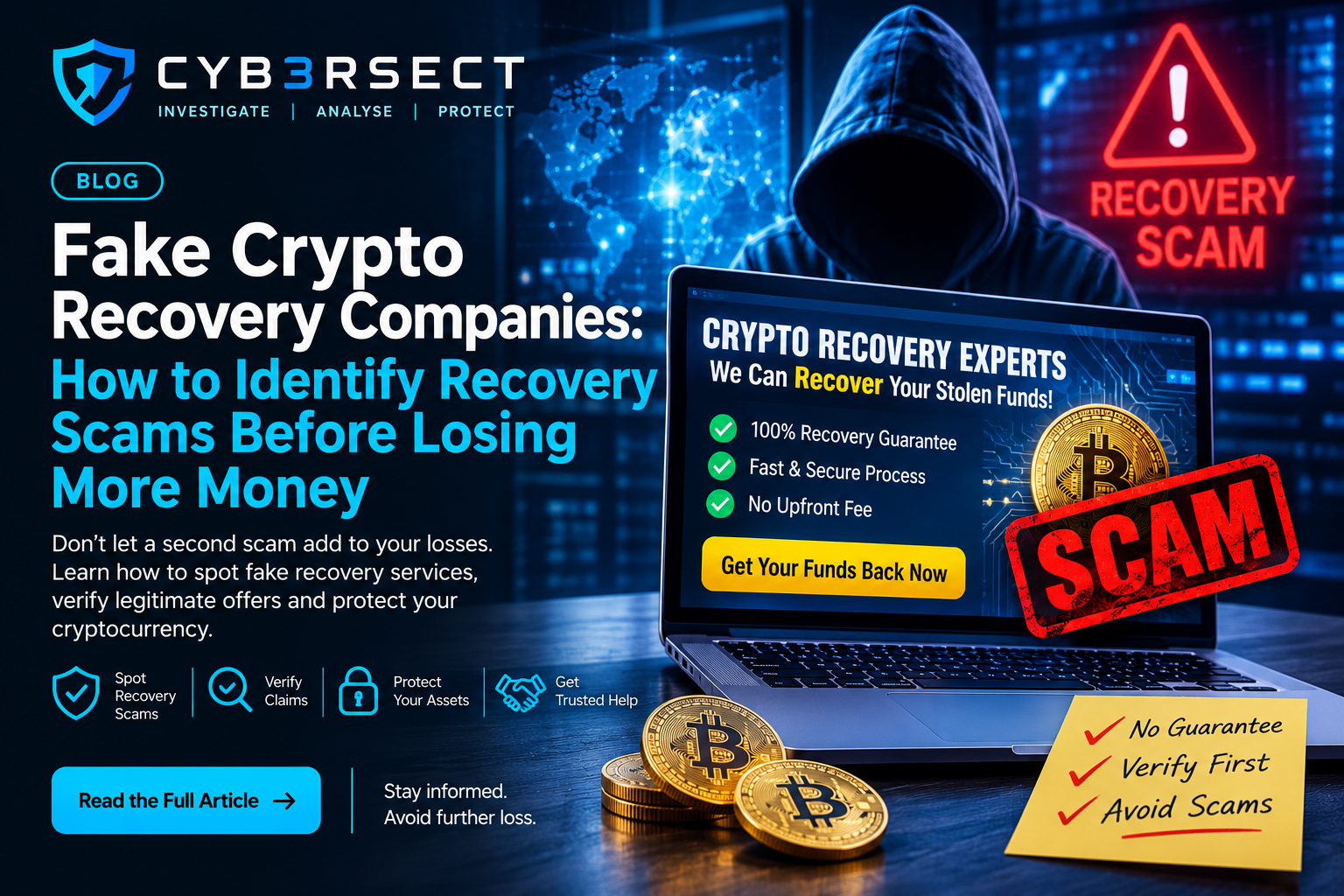
Fake Crypto Recovery Companies: How to Identify Recovery Scams Before Losing More Money
Losing cryptocurrency to a suspicious investment platform can be devastating. But for many victims, the first incident is not necessarily the last.
After discovering that an exchange will not release their funds, a trading platform has disappeared or an investment representative has stopped responding, victims may begin searching for ways to recover their cryptocurrency.
That is when another group of people may appear.
They call themselves recovery specialists, blockchain investigators, asset recovery agents, legal representatives or cryptocurrency tracing experts. Some claim they have already located the missing funds. Others say they can access frozen wallets, reverse transactions or recover cryptocurrency through private connections.
Their promises can sound convincing, particularly to someone who has already experienced a financial loss.
However, fake crypto recovery services can turn an existing fraud into a second one.
At Cyb3rsect, we believe that people dealing with cryptocurrency fraud deserve clear information, evidence-based investigation and realistic explanations—not another set of promises they cannot verify.
This guide explains how recovery scams operate, which warning signs to look for and how to assess whether a cryptocurrency investigation service is credible.
1. What is a cryptocurrency recovery scam?
A cryptocurrency recovery scam occurs when someone offers to retrieve cryptocurrency lost through fraud, theft or an investment scheme but uses the offer to obtain further money, sensitive information or account access.
The person may claim to have specialist blockchain tools, access to law-enforcement systems, contacts at cryptocurrency exchanges or the ability to recover assets from wallets controlled by criminals.
The supposed service may involve:
- An upfront investigation or registration payment.
- A fee to unlock a frozen wallet.
- A supposed tax or clearance payment.
- A request for cryptocurrency to activate a recovery process.
- A demand for private keys or wallet recovery phrases.
- Remote access to a victim’s computer or mobile device.
Some operators use professional-looking websites and fabricated testimonials. Others contact victims directly through social media, messaging applications or email.
The central problem is that the promised recovery may not exist. Instead, the operator uses the victim’s desire to retrieve lost funds as an opportunity to demand another payment.
2. How fake recovery companies find cryptocurrency fraud victims
Recovery scammers may approach victims in several ways.
Unsolicited social media messages
A person may receive a message from an account claiming to specialise in cryptocurrency recovery. The sender may say they noticed a complaint, saw a public post about a loss or were referred by another victim.
They may immediately claim to know how to retrieve the funds.
Be cautious when someone you have never contacted approaches you with a specific recovery promise.
Fake recovery advertisements
Some operators advertise services through search engines, social media and websites. Their advertisements may use phrases such as:
- Recover stolen Bitcoin.
- Retrieve lost cryptocurrency.
- Unlock frozen crypto accounts.
- Trace and recover stolen digital assets.
- Guaranteed blockchain recovery.
Advertising does not establish legitimacy. A company appearing in search results has not necessarily been independently verified.
Comments on scam reports and complaint websites
People who publicly describe a cryptocurrency loss may receive replies from supposed investigators or recovery specialists.
Some comments appear supportive and direct the victim to a particular contact. Others may recommend a service through an account that has little independent history.
Treat unsolicited recommendations carefully. Verify the business independently before sharing information or making contact.
Impersonation of legitimate organisations
A recovery scammer may use the name, logo or identity of an established company, law firm, government agency or cryptocurrency exchange.
The person may claim that the organisation has already located the assets or is waiting for a payment before releasing them.
Contact the genuine organisation through independently obtained details. Do not rely on telephone numbers, links or email addresses supplied by the person making the recovery offer.
3. The most common warning signs of a fake crypto recovery service
A recovery service should be examined just as carefully as the original investment platform.
The following warning signs deserve particular attention.
Guaranteed recovery
No investigator can honestly guarantee that cryptocurrency will be recovered in every case.
Blockchain analysis may identify transaction flows and provide useful investigative leads. It does not automatically establish who controls a wallet or provide the legal authority to retrieve assets.
Be cautious of claims such as:
- We guarantee your money back.
- We recover every stolen Bitcoin.
- Your funds are already secured.
- We can reverse any crypto transaction.
- Recovery is certain once you pay our fee.
A credible provider should explain the limitations of the proposed work.
Requests for upfront cryptocurrency payments
Some legitimate professional services charge for investigative work. The existence of a fee does not automatically make a business fraudulent.
The concern is an unexplained payment demand, especially when the operator insists that cryptocurrency must be sent to a personal wallet before any meaningful information is provided.
Before paying for a service, obtain a written scope of work, fee explanation, business identity and description of the deliverables.
Claims of special access to blockchain systems
A person may claim they can access private blockchain databases, control exchange wallets or reverse transactions through a special recovery system.
Public blockchain networks do not generally provide a mechanism for an investigator to reverse a confirmed transaction simply because it resulted from fraud.
An exchange or other service provider may have processes for reviewing suspicious activity, but those processes are not the same as an investigator independently controlling customer funds.
Ask the provider to explain precisely what technical work it proposes to perform.
Requests for private keys or recovery phrases
This is a serious warning sign.
Your wallet recovery phrase or private key can provide control over your cryptocurrency. Do not disclose it to a recovery agent, investigator, support representative or anyone else claiming to help.
A legitimate blockchain investigation should not require you to hand over your private keys merely to examine public transaction records.
Pressure to act immediately
Recovery scammers may claim that a short deadline is approaching, that assets are about to disappear or that a special recovery window will close.
This pressure is designed to discourage careful verification.
Do not let urgency prevent you from checking the company, reviewing its terms and obtaining independent advice.
4. Common stories recovery scammers use
Recovery scammers often adapt their explanations to the circumstances of the original loss.
The frozen wallet story
The operator claims that the stolen cryptocurrency has been located in a frozen wallet and only needs an administrative payment to be released.
Ask which organisation allegedly froze the assets, what authority it has and whether the claim can be verified independently.
The blockchain tax story
The operator says that tax must be paid directly to the recovery company before cryptocurrency can be returned.
Tax obligations depend on the relevant jurisdiction and circumstances. A private recovery agent’s demand should not be treated as proof of a genuine tax liability.
Verify tax claims through the relevant tax authority or a qualified professional.
The exchange insider story
The operator claims to have an employee or contact inside a major cryptocurrency exchange who can release funds.
Ask for verifiable details and an explanation of the lawful process. Claims of confidential access should not replace evidence.
The law-enforcement connection story
Some operators claim to work with police, government agencies or international investigators.
A genuine affiliation should be independently verifiable. Do not accept a badge image, copied letterhead or unofficial email as proof of government authority.
The blockchain reversal story
The operator claims that a special tool can reverse a confirmed cryptocurrency transaction.
Blockchain transaction finality varies by network, but a confirmed transfer generally cannot be reversed through an ordinary request to an independent investigator.
Where assets reach a centralised exchange or another identifiable service, there may be reporting or legal processes worth exploring. That is different from promising a universal reversal mechanism.
5. What legitimate cryptocurrency investigation can actually do
It is important to distinguish a genuine investigation from a promise of guaranteed recovery.
A properly scoped investigation may help establish what happened, organise available evidence and identify useful investigative leads.
Depending on the case, available records and lawful authority, work may include:
Blockchain transaction analysis: Reviewing public transaction records, wallet addresses, transaction identifiers, timestamps and visible movement of assets.
Platform research: Examining websites, domain information, claimed business identities and available regulatory disclosures.
Communication analysis: Reviewing emails, messages, payment instructions and contact details associated with the suspected fraud.
Digital evidence preservation: Organising screenshots, account records, transaction receipts and original communications.
Timeline reconstruction: Connecting important events, including initial contact, deposits, withdrawal attempts and subsequent payment demands.
Investigative reporting: Documenting findings, methods, limitations and areas that may require further enquiries.
These activities can provide useful information. However, tracing a transaction is not the same as identifying the person controlling an address, obtaining access to assets or securing a legal recovery.
A responsible investigator should explain that distinction clearly.
6. How to verify a cryptocurrency recovery company before hiring it
Before sharing sensitive information or paying for an investigation, carry out independent checks.
Verify the legal business identity
Ask for the provider’s full legal business name, jurisdiction, registration information and business address.
Check the information against relevant official records. Make sure the company named in the agreement is the same entity you are communicating with.
Examine the people behind the service
Look for verifiable professional backgrounds and relevant experience.
Be cautious of impressive job titles or biographies that cannot be independently confirmed. A photograph, social media profile or professional-looking website does not establish investigative competence.
Review the proposed investigation
A credible provider should be able to explain:
- What information it needs.
- Which investigative activities are proposed.
- What is included in the service.
- What the service cannot establish.
- What the expected deliverables are.
- What fees apply.
- How your information will be protected.
If the provider cannot explain the work beyond saying that it will recover your money, ask further questions before proceeding.
Examine the contract and payment terms
Read the written agreement carefully.
It should identify the service provider, define the scope, explain fees and describe the deliverables. It should also address confidentiality, data handling and termination arrangements.
Avoid paying through an unexplained wallet address or a payment route that cannot be linked to the stated business.
Look for independent evidence of reputation
Search for the exact business name, website domain and contact details.
Check whether the company has a consistent online history and whether its claimed experience can be verified.
Testimonials can be useful background information, but they should not be treated as proof that a company can recover cryptocurrency.
7. What to do if you have already paid a recovery scammer
If you suspect that a recovery service has defrauded you, stop communicating through the channels it supplied and avoid making further payments.
Take the following steps.
Stop additional transfers. Do not pay another supposed tax, clearance charge or release fee.
Preserve communications. Save emails, messages, usernames, telephone numbers, attachments and payment instructions.
Record payment details. Keep bank confirmations, card statements, cryptocurrency transaction hashes and recipient wallet addresses.
Secure your accounts. Change compromised passwords, revoke suspicious sessions and secure your email and exchange accounts.
Review remote access. If you installed software at the operator’s request, disconnect the session and seek help checking the device.
Contact your payment provider. Use official channels to report the payment and ask what options may be available.
Report the incident. Depending on your location, consider contacting the appropriate law-enforcement, consumer-protection or financial regulator.
If you are in the United States, the FBI’s Internet Crime Complaint Center and the Federal Trade Commission provide reporting channels for different types of online fraud.
Do not delete evidence simply because the recovery company has stopped responding.
8. Evidence to preserve during a recovery-scam investigation
A second fraud can involve different people, websites, wallets and payment methods from the original investment scam.
Keep the two incidents clearly documented.
Useful evidence may include:
- The recovery company’s exact website address.
- The legal name it claims to operate under.
- Names and contact details of representatives.
- Emails and complete messaging histories.
- Written recovery proposals and contracts.
- Payment demands and explanations.
- Wallet addresses and transaction hashes.
- Bank or card payment confirmations.
- Screenshots of claimed recovery results.
- Any documents claiming government or exchange involvement.
Record the date and time of important events. Preserve original files where possible and work from copies.
Cyb3rsect’s guide to preserving digital evidence for cybercrime and fraud investigations explains why evidence should be retained and organised carefully.
9. Can a blockchain investigator recover stolen cryptocurrency?
This is one of the most important questions to ask before engaging a recovery service.
Blockchain analysis can help follow visible transactions and identify patterns in the movement of cryptocurrency. Depending on the network and available information, an investigator may identify addresses receiving funds, subsequent transfers and possible connections to known services.
However, several limitations remain.
A wallet address does not automatically reveal the identity of the person controlling it. A transaction path may involve multiple intermediaries. Funds may move through services that require formal legal processes before customer information can be disclosed.
An investigator may produce findings that support a report or further action, but cannot independently compel an exchange to release assets or guarantee that a recipient can be identified.
Any provider suggesting otherwise should explain the specific legal and technical basis for its claim.
10. Questions to ask before hiring a recovery investigator
Use these questions to assess whether a provider is offering a genuine investigative service.
- What is the full legal name of your business?
- Where is the business registered?
- Who will carry out the investigation?
- What specific work will be performed?
- What information do you need from me?
- Will you ever need my private key or recovery phrase?
- What written deliverables will I receive?
- What are the limitations of the investigation?
- How are fees calculated?
- Do you guarantee recovery, and if so, what is the factual basis for that guarantee?
A responsible provider should be willing to answer these questions clearly. If the answers rely on pressure, secrecy or vague claims of special access, reconsider the engagement.
11. How Cyb3rsect approaches cryptocurrency fraud investigations
Cyb3rsect focuses on digital investigations, online fraud intelligence and evidence-based analysis.
When a person reports a suspicious recovery offer or cryptocurrency investment incident, the available evidence may be examined within an agreed and authorised scope.
Depending on the circumstances, this may involve reviewing platform information, examining communications, organising payment records, analysing relevant blockchain transactions and documenting a chronology of events.
The aim is to provide a clear assessment of what the available information supports, what remains uncertain and what further steps may be appropriate.
Cyb3rsect does not promise guaranteed recovery, automatic wallet access or the reversal of confirmed blockchain transactions. Any investigation should be based on the actual evidence, technical limitations and applicable legal requirements.
For more information about reporting standards, see what a professional digital forensic report should contain.
Final thoughts: do not let a second scam follow the first
People who lose cryptocurrency may be particularly vulnerable to promises of recovery. They may be searching for answers, facing financial pressure and hoping that someone can help them retrieve their assets.
That is exactly why recovery offers should be examined carefully.
A professional website, impressive testimonials, claims of government connections or promises of guaranteed results are not proof of legitimacy. Verify the business, understand the proposed investigation, protect your wallet credentials and never allow pressure to dictate a financial decision.
If you have already lost cryptocurrency, preserving accurate evidence and understanding the available investigative options are sensible first steps.
If you need help reviewing a suspicious recovery offer or organising evidence connected to a cryptocurrency incident, visit Cyb3rsect to learn more about digital investigations and evidence-focused support.
