

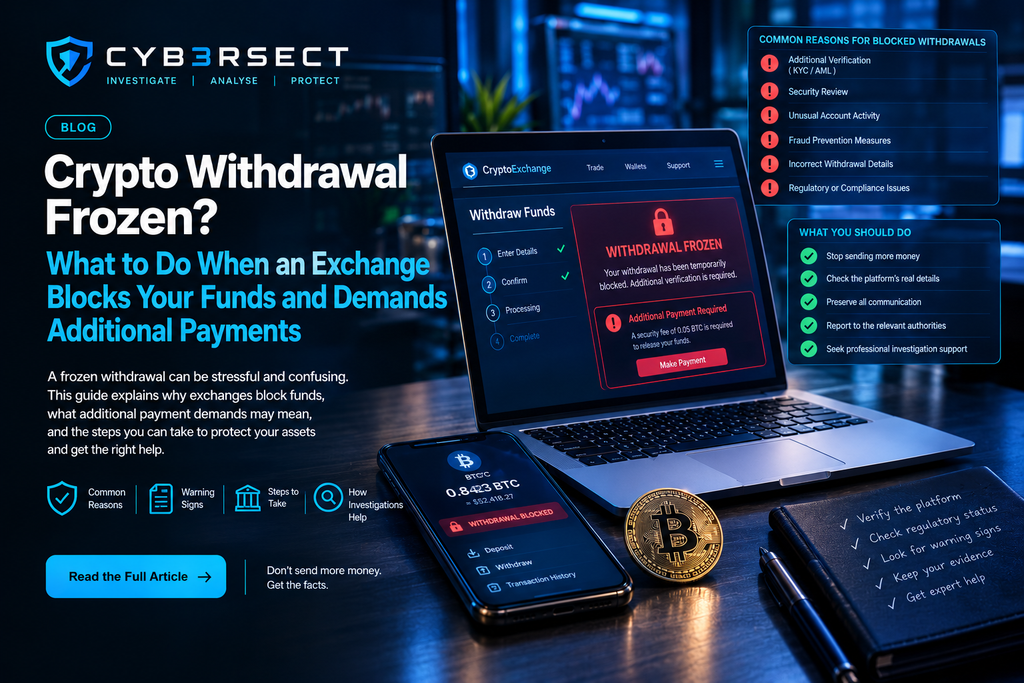
Crypto Withdrawal Frozen? What to Do When an Exchange Blocks Your Funds and Demands Additional Payments
You log in to your cryptocurrency account, request a withdrawal and expect your funds to arrive. Instead, the transaction remains pending. Customer support tells you that your account requires additional verification. A few hours later, you receive another message asking for a payment before the withdrawal can be released.
For cryptocurrency investors, this situation can be confusing and stressful. You may not know whether the exchange is conducting a legitimate security review, experiencing a technical problem or deliberately preventing you from accessing your money.
Unfortunately, blocked withdrawals are also a common feature of cryptocurrency investment scams. Fraudulent platforms may display account balances and apparent profits while refusing to release funds. They may then introduce new charges described as taxes, verification fees, liquidity deposits or account-unlocking payments.
Not every delayed withdrawal is fraudulent. Legitimate exchanges may restrict transactions because of identity checks, suspicious account activity, compliance obligations, network congestion or technical problems. The important question is whether the explanation is genuine, consistent with the platform’s published policies and independently verifiable.
At Cyb3rsect, our focus is digital investigations, online fraud intelligence and evidence-based analysis. This guide explains why cryptocurrency withdrawals may be blocked, which warning signs deserve attention and what to do before sending additional money.
1. Why would a cryptocurrency exchange freeze a withdrawal?
A withdrawal restriction can occur for several reasons. Understanding the possible explanations helps distinguish an ordinary operational issue from a potentially fraudulent situation.
Identity verification requirements
An exchange may request additional identity information before processing a withdrawal. This can happen when customer records are incomplete, documents have expired or an account requires further verification.
The exchange should explain what information is required and provide a process for submitting it through an official, secure channel.
Be cautious if someone asks you to send identity documents through an unfamiliar messaging account or personal email address.
Suspicious account activity
An exchange may temporarily restrict withdrawals after detecting unusual login activity, unexpected device changes or transactions that differ from normal account behaviour.
These controls can help protect customers from account takeover and unauthorised transfers.
You should be able to obtain an explanation through the platform’s verified support channels.
Compliance and regulatory reviews
Financial-service providers may have obligations to review certain transactions or customer accounts. These obligations vary by jurisdiction, business model and the circumstances of the transaction.
A compliance review may delay access to funds. However, a demand for an additional cryptocurrency payment should not be accepted merely because someone describes it as a regulatory requirement.
Verify the legal basis of any claimed tax, fee or regulatory charge independently.
Network or technical problems
Cryptocurrency transactions can be delayed by blockchain network conditions, exchange maintenance or processing problems.
Check whether the exchange has published a service-status announcement. If a transaction has already been broadcast, examine whether a transaction identifier is available.
A pending internal withdrawal and a transaction confirmed on a blockchain are not the same thing.
2. When a frozen withdrawal becomes a warning sign
A withdrawal delay deserves closer examination when the platform’s explanations change, its support team becomes evasive or new payment demands appear.
Watch for these warning signs:
- You are asked to deposit more cryptocurrency before receiving your existing balance.
- A new tax or release charge appears only after you request a withdrawal.
- The platform refuses to explain the contractual basis of the charge.
- Support representatives communicate through unofficial accounts.
- You are threatened with losing your entire balance unless you pay immediately.
- The website displays profits but provides no independently verifiable transaction records.
- The company name, payment recipient or wallet address changes unexpectedly.
- You cannot contact the business through independently verified channels.
One warning sign alone does not prove fraud. However, several unexplained demands combined with a refusal to release funds should prompt you to stop and investigate.
3. The additional-payment trap: taxes, verification fees and release charges
One of the most concerning patterns involves a platform demanding more money before allowing a withdrawal.
A customer may initially be told that their account balance is available. When they request payment, the platform introduces a new condition.
The charge might be described as:
A tax payment: The representative claims that tax must be paid directly to the platform before funds can be released.
A security deposit: The customer is told to deposit additional funds to prove ownership or activate a withdrawal facility.
A liquidity fee: The platform claims that a payment is required to provide liquidity for the withdrawal.
An account verification charge: The customer is asked to transfer cryptocurrency to complete a verification process.
An unlocking fee: The operator claims that a payment will remove a restriction on the account.
Some legitimate financial services charge disclosed fees, and tax obligations can arise in genuine transactions. The warning sign is an unexpected or unverifiable payment demand that is presented as the only way to access funds.
Do not assume a charge is legitimate because it appears in a dashboard or comes from someone using professional financial terminology.
Ask for the relevant contractual provision, the legal entity receiving the payment and an independently verifiable explanation. If the platform insists that you must pay immediately, pause before transferring anything.
4. Do not confuse an account balance with recoverable funds
A trading platform may display a balance that appears to represent cryptocurrency or investment profits.
However, an internal dashboard is not independent proof that the corresponding assets exist or are available for withdrawal.
A displayed balance may be based on the platform’s internal records. It may not correspond to a wallet holding the stated amount.
Where appropriate, ask whether the platform can provide:
- A clear account statement.
- A transaction history.
- Relevant blockchain transaction identifiers.
- The network used for deposits and withdrawals.
- An explanation of any withdrawal restriction.
- A copy of the applicable withdrawal terms.
A blockchain transaction identifier can help establish that a transaction was recorded on a particular network. It does not automatically establish who controls a wallet or whether the platform has sufficient assets to meet customer obligations.
5. What to do immediately when your withdrawal is blocked
If you encounter an unexpected withdrawal restriction, avoid making decisions under pressure.
Follow these steps.
Step 1: Stop sending additional funds
Do not make another deposit simply because someone promises to release your existing balance.
This is particularly important when the new payment demand was not disclosed before you invested.
Step 2: Contact the platform through verified channels
Use contact details obtained independently from the platform’s official website or verified company records.
Ask for a written explanation of the restriction, the status of your withdrawal and the relevant terms or policy.
Do not rely solely on a telephone number or messaging account supplied by the person requesting payment.
Step 3: Secure your accounts
If you suspect that your login details or device may have been compromised:
- Change affected passwords from a trusted device.
- Revoke unfamiliar sessions.
- Enable appropriate multifactor authentication.
- Review connected applications.
- Secure your associated email account.
- Never share private keys or wallet recovery phrases.
If you granted remote access to someone you no longer trust, disconnect the session and review the device for possible compromise.
Step 4: Contact the service that handled your payment
If you deposited through a bank, card provider or cryptocurrency exchange, contact its official support team.
Explain that you suspect an investment-related fraud or unauthorised payment. Ask what reporting, dispute or account-protection options may be available.
The available options depend on the payment method and circumstances. Cryptocurrency transfers confirmed on a blockchain are generally not reversible through a normal customer-service request.
Step 5: Preserve the evidence
Do not delete your account, messages or transaction history simply because the platform is no longer responding.
Preserve the information before access disappears.
6. Evidence you should preserve before the platform disappears
Digital evidence can become difficult to obtain when a suspicious website changes its content, removes customer access or stops operating.
Keep copies of the following where available:
Website information
- Exact domain name and relevant page addresses.
- Screenshots of the website and account dashboard.
- Terms and conditions.
- Privacy policy and company disclosures.
- Withdrawal instructions and error messages.
Communications
- Original emails.
- Email headers where available.
- Messaging histories.
- Telephone numbers and usernames.
- Names and identities claimed by representatives.
- Voice messages and attachments.
Financial records
- Bank or card payment confirmations.
- Cryptocurrency exchange receipts.
- Wallet addresses.
- Transaction hashes.
- Dates, times and amounts.
- Payment instructions and explanations.
Account information
- Account identifiers.
- Deposit and withdrawal history.
- Screenshots of displayed balances.
- Support ticket numbers.
- Records of account restrictions.
Keep original files where possible and create separate working copies. Record when and how important information was obtained.
Cyb3rsect’s guide to digital evidence preservation explains why organised evidence and documented handling can be important during an investigation.
7. Can blockchain analysis help investigate blocked withdrawals?
Blockchain analysis can be useful when cryptocurrency has been transferred to a platform or wallet associated with a suspected fraud.
Depending on the network and available records, investigators may examine:
- The original deposit transaction.
- The receiving wallet address.
- Subsequent transfers visible on the blockchain.
- Transaction dates and amounts.
- Relationships between visible wallet addresses.
- Transfers involving publicly identifiable services, where evidence supports the association.
This can help reconstruct the movement of cryptocurrency.
However, there are important limitations.
A wallet address does not automatically reveal the identity of its controller. A visible transfer does not prove that a particular individual or company committed fraud. Some transactions may involve exchanges, custodians, intermediaries or services that require additional evidence to understand.
Blockchain analysis should therefore be combined with other records, such as communications, payment confirmations, website information and account documentation.
For further background, see Cyb3rsect’s information on cryptocurrency wallet tracing.
8. How to investigate the platform behind the blocked withdrawal
A blocked withdrawal should not be examined in isolation. The platform itself may provide important information about what happened.
A structured review may consider:
Company identity
Identify the legal entity operating the website. Compare its name, address and company details with independently available records.
Regulatory claims
Check any claimed licence or authorisation through the relevant regulator’s official register. Confirm that the permission covers the advertised activity.
Domain history
Review available domain-registration information and compare the website’s claimed operating history with its online presence.
Payment instructions
Examine the recipient details, wallet addresses and explanations supplied when deposits or additional fees were requested.
Communications
Review the messages exchanged with account managers and support representatives. Look for changing explanations, inconsistent identities and pressure tactics.
Withdrawal history
Create a timeline of deposit requests, withdrawal attempts, restrictions and additional payment demands.
The objective is to identify what can be established from the evidence and what requires further investigation.
9. Beware of recovery agents who contact you afterwards
People who experience blocked withdrawals may be targeted again by supposed recovery specialists.
These individuals may claim to have located the funds, obtained access to frozen wallets or secured cooperation from an exchange or government agency.
They may then demand an advance payment, administrative charge or wallet activation fee.
Be cautious if anyone:
- Guarantees that your cryptocurrency will be recovered.
- Claims they can reverse a confirmed blockchain transaction.
- Requests your private key or recovery phrase.
- Demands payment before explaining the work.
- Claims to represent law enforcement without verifiable authority.
- Pressures you to act before a supposed recovery deadline.
A legitimate investigation should explain the proposed work, evidence requirements, limitations, costs and reporting arrangements. No investigator should promise an outcome that depends on third parties or assets they do not control.
10. Where to report a suspected cryptocurrency investment fraud
Reporting options depend on your location, the payment method and the nature of the incident.
In the United States, relevant channels may include:
- FBI Internet Crime Complaint Center (IC3): online crime and suspected internet fraud.
- Federal Trade Commission (FTC): consumer fraud reporting.
- Securities and Exchange Commission (SEC): potential securities-related misconduct.
- Commodity Futures Trading Commission (CFTC): relevant commodities and derivatives-related concerns.
- State financial regulators: matters involving businesses or activities regulated at state level.
- Your bank or cryptocurrency exchange: payment-related concerns and account security.
Use official agency websites to identify the correct reporting process.
A report should be factual and organised. Include relevant dates, payment information, website details, communications and transaction identifiers. Avoid presenting assumptions as confirmed facts.
11. How Cyb3rsect can help organise a digital investigation
When a cryptocurrency withdrawal is blocked and the platform begins making unexplained demands, it can be difficult to understand the available evidence.
A structured investigation may help organise the information and establish a clearer timeline.
Depending on the agreed scope, available records and legal authority, work may include:
- Reviewing suspicious platform websites.
- Examining claimed company identities and regulatory information.
- Organising communications and payment records.
- Reviewing relevant blockchain transactions.
- Identifying inconsistencies in withdrawal instructions.
- Building an event timeline.
- Preparing documented findings and limitations.
The objective is to provide an evidence-based assessment, not to promise that funds can be recovered or that a particular person can be identified.
Cyb3rsect focuses on digital investigations, online fraud intelligence and evidence-focused reporting. The appropriate scope depends on the circumstances and information available.
For additional information, read what a professional digital forensic report should contain.
A practical checklist if your crypto withdrawal is frozen
- Stop sending additional funds.
- Save the exact website address.
- Record the withdrawal error or restriction message.
- Preserve all conversations with representatives.
- Save deposit and transaction records.
- Record wallet addresses and transaction hashes.
- Verify the company’s legal identity.
- Check regulatory claims independently.
- Secure your email and exchange accounts.
- Contact the payment provider through official channels.
- Consider reporting the incident to the appropriate authority.
- Be cautious of unsolicited recovery offers.
Final thoughts: do not pay more just to access your own money
A frozen cryptocurrency withdrawal can have legitimate explanations, but unexpected payment demands should never be accepted without independent verification.
If an exchange suddenly requires a new deposit, tax payment or security charge before releasing funds, pause and examine the evidence. Preserve your records, secure your accounts and use official reporting channels where appropriate.
The most important thing is to avoid allowing pressure or fear of losing an existing balance to lead to another financial transfer.
If you are dealing with a suspicious trading platform, blocked cryptocurrency withdrawal or unexplained payment demand, visit Cyb3rsect to learn more about digital investigations and evidence-focused support.
Cyb3rsect — Investigate. Analyse. Protect.
