

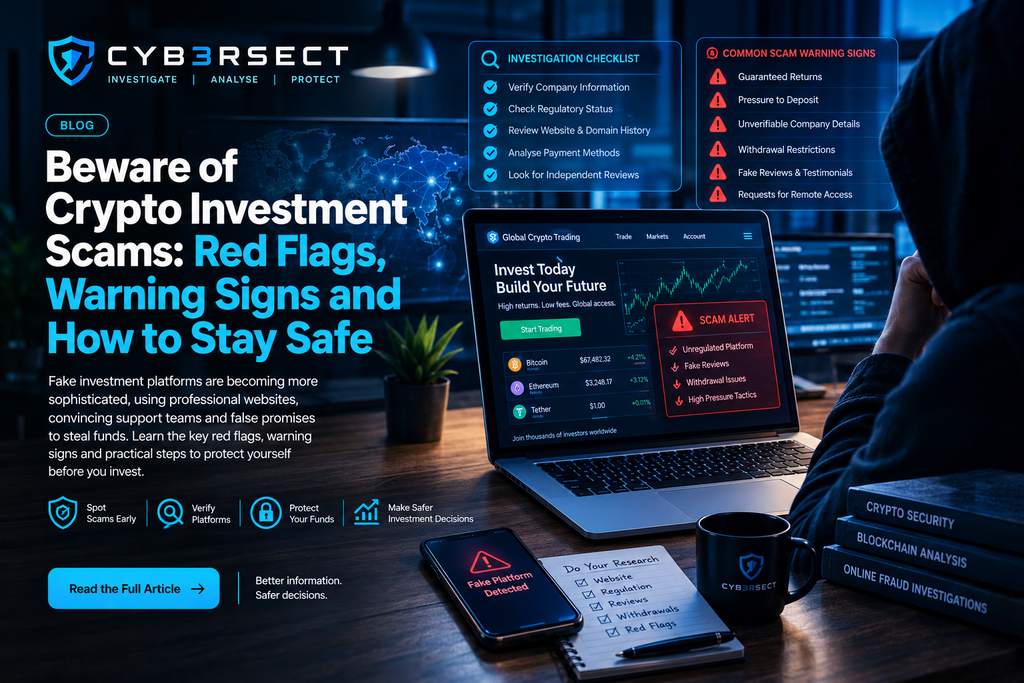
Beware of Crypto Investment Scams: Red Flags, Warning Signs and How to Stay Safe
Cryptocurrency investment scams are becoming increasingly convincing. Fraudulent operators can create professional-looking trading websites, display impressive account dashboards, use fabricated testimonials and communicate through people who appear to be experienced financial advisers.
Some victims are approached through social media. Others discover an investment opportunity through an online advertisement, messaging group or unsolicited phone call. The approach may be different, but the objective is often similar: establish trust, encourage an initial deposit and persuade the person to send more money.
A platform may even display apparent trading profits to make an investment seem successful. The problem often becomes clear when a customer attempts to withdraw funds and encounters unexpected restrictions, additional payment demands or silence from the people managing the account.
Recognising the warning signs early can help prevent financial harm.
At Cyb3rsect, our focus is digital investigations, online fraud intelligence and evidence-focused analysis. This guide explains how crypto investment scams commonly operate, which warning signs deserve attention and how to preserve useful information if you suspect you have been targeted.
1. Promises of guaranteed cryptocurrency returns
One of the clearest warning signs is a promise that an investment will generate guaranteed profits.
Cryptocurrency markets can be volatile. Prices may rise or fall quickly, and even experienced traders cannot guarantee consistent returns.
Be cautious when someone claims:
- Your investment cannot lose money.
- Profits are guaranteed every day or week.
- A trading system produces consistent returns regardless of market conditions.
- An opportunity has no risk because an expert manages everything.
- You must invest immediately to secure a guaranteed profit.
A genuine investment provider should explain the risks associated with its services. Claims of certainty should be independently examined rather than accepted as evidence of legitimacy.
2. Pressure to deposit more money
Fraudulent investment operators may create urgency to prevent potential customers from conducting independent research.
They might claim that an opportunity is available for only a short period, that a special trading position is about to close or that a larger deposit is required to unlock better returns.
Pressure tactics can include:
- Limited-time investment offers.
- Claims that a deposit must be made immediately.
- Repeated calls or messages from account managers.
- Promises of exclusive access to profitable trades.
- Suggestions that delaying will result in losing an opportunity.
Take time to verify the company and its claims. A legitimate business should not need to prevent you from carrying out basic checks before committing funds.
3. Fake cryptocurrency trading dashboards
A professional trading dashboard does not prove that real trading is taking place.
Some fraudulent platforms display account balances, transaction histories and apparent profits that are controlled internally by the website operator.
A customer may see an account balance increasing over time and believe that their investment is performing well. However, the displayed figures may not correspond to cryptocurrency held in a wallet or transactions recorded on a blockchain.
Questions worth asking include:
- Can the transactions be independently verified?
- Are blockchain transaction identifiers available where appropriate?
- Does the platform explain how balances are calculated?
- Can withdrawals be completed under the published terms?
- Does the company provide consistent and verifiable account records?
A screenshot of a profitable account is not proof that funds exist or can be withdrawn.
4. Unexpected withdrawal fees and release payments
One of the most concerning warning signs occurs when a platform accepts deposits but creates new conditions when a customer tries to withdraw.
The operator may claim that the customer must pay:
- A withdrawal-processing fee.
- An account-verification charge.
- A tax or regulatory payment.
- A security deposit.
- A liquidity fee.
- A wallet-activation charge.
Some fees are legitimate in financial services, but an unexpected payment demand should always be independently verified.
Be especially cautious if the platform insists that an additional cryptocurrency transfer is the only way to release an existing balance.
Do not send more funds simply because someone promises that doing so will unlock your account. Ask for the contractual basis of the charge and verify any tax or regulatory claim with the relevant authority.
5. Unverifiable company and regulatory information
A platform may display a company registration number, licence reference, office address or regulatory logo to create an impression of legitimacy.
These details should be checked independently.
Start by identifying the legal entity named in the platform’s terms and conditions. Then compare that information with official company and financial-regulator records.
Check whether:
- The registered company actually exists.
- Its legal name matches the website’s disclosures.
- Its address is consistent across records.
- Its claimed regulatory permissions can be verified.
- The permission covers the services being advertised.
- The company has been subject to relevant regulatory warnings.
Remember that company registration does not automatically mean a business is authorised to offer investment services.
6. Impersonation of legitimate companies and professionals
Some investment scams use the names, photographs and branding of genuine companies or financial professionals.
A fraudulent website may copy the appearance of an established exchange. A salesperson may claim to work for a recognised financial institution. A social media profile may use another person’s photograph and professional biography.
This is known as impersonation.
Before trusting someone promoting an investment, verify their identity through independently obtained company contact details. Do not rely solely on telephone numbers, email addresses or links supplied by the person contacting you.
Be particularly cautious when a representative discourages you from contacting the company through its official website.
7. Unsolicited messages and private investment groups
Investment opportunities promoted through social media and messaging applications deserve careful scrutiny.
A person may approach you with a trading tip, invite you to a private cryptocurrency group or introduce you to an alleged expert who offers investment guidance.
The group may contain multiple accounts praising the same platform and sharing apparent profits.
However, online activity can be manipulated. Several accounts may be controlled by the same operator, and testimonials may be fabricated.
Watch for:
- Unsolicited investment invitations.
- Groups dominated by repetitive success stories.
- Pressure to move conversations into private messages.
- Requests to deposit through unfamiliar websites.
- Claims that members have access to exclusive trading information.
- Instructions to keep the investment secret.
Independent verification is essential, particularly when the person making the recommendation has no established relationship with you.
8. Requests to install remote-access software
A person claiming to be an investment adviser or technical-support representative may ask you to install software that allows them to view or control your device.
Remote-access software can have legitimate uses, but granting control to an unverified person creates serious security risks.
They may attempt to view:
- Banking applications.
- Cryptocurrency exchange accounts.
- Email inboxes.
- Password managers.
- Wallet interfaces.
- Authentication information.
Never share private keys, recovery phrases or one-time authentication codes with someone claiming to help manage an investment.
If you have already granted remote access to someone you now suspect is fraudulent, disconnect the session and secure affected accounts from a trusted device. Consider professional assistance if sensitive information may have been exposed.
9. Unusual cryptocurrency payment instructions
The way a platform requests payment can provide useful information.
Be cautious when you are instructed to transfer cryptocurrency to a personal wallet or an address that cannot be linked to the stated business through independently verifiable information.
Other warning signs include:
- Payment instructions that change unexpectedly.
- Transfers to unrelated individuals or businesses.
- Requests to use unfamiliar exchanges.
- Instructions to divide payments between multiple wallets without a clear explanation.
- Pressure to avoid ordinary banking channels.
A wallet address alone does not establish who controls it. However, transaction details can help investigators examine the movement of funds and identify relationships between visible blockchain addresses.
10. What to do if you suspect a crypto investment scam
If you believe you have been targeted, take action carefully. Avoid making additional payments while you assess the situation.
Stop sending money. Do not pay unexpected withdrawal charges or make another deposit to unlock an account.
Preserve communications. Save emails, messages, chat histories, telephone numbers and contact details.
Record the platform information. Keep the exact website address, account identifiers, screenshots and relevant terms and conditions.
Save payment records. Preserve bank receipts, card statements, cryptocurrency exchange records, wallet addresses and transaction hashes.
Secure your accounts. Change compromised passwords, revoke suspicious sessions and enable appropriate multifactor authentication.
Contact your payment provider. Use its official contact channel and explain the circumstances. Available options depend on the payment method and timing.
Report the incident. Consider reporting to the relevant financial regulator, consumer-protection agency or law-enforcement organisation.
In the United States, the FBI’s Internet Crime Complaint Center (IC3) and the Federal Trade Commission provide reporting channels for different types of online fraud.
Reporting an incident does not guarantee recovery, but preserving accurate information can help support further enquiries.
11. Preserve digital evidence before it disappears
Evidence can become harder to obtain as a suspicious platform changes its website, removes account access or stops responding.
Preserve original information wherever possible.
Useful material may include:
- The complete website address.
- Screenshots of account balances and withdrawal messages.
- Original emails with their available headers.
- Messaging histories and attachments.
- Transaction identifiers and wallet addresses.
- Payment confirmations.
- Recorded dates and times of important events.
- Names and contact details used by representatives.
Do not alter original files unnecessarily. Keep copies of relevant material and maintain a simple timeline explaining when each event occurred.
Cyb3rsect’s guide to digital evidence preservation explains why preserving records and documenting evidence handling can be important during an investigation.
12. Be careful of cryptocurrency recovery scams
After losing money, victims may be contacted by people claiming they can recover cryptocurrency.
Some claim to be specialist recovery agents, blockchain investigators, lawyers or government representatives. They may promise access to frozen funds or say they have identified the person responsible.
Warning signs include:
- Guaranteed recovery promises.
- Requests for advance payments without a clear written scope.
- Demands for private keys or recovery phrases.
- Claims that cryptocurrency transactions can simply be reversed.
- Pressure to act immediately.
- Unverifiable legal or government affiliations.
Blockchain analysis can help examine transaction flows, but tracing an address does not automatically identify its controller or guarantee that assets can be recovered.
A credible investigation should explain what can realistically be examined, what evidence is required, what limitations apply and what deliverables will be provided.
How Cyb3rsect approaches suspicious platform investigations
When a cryptocurrency platform raises concerns, the available evidence should be examined systematically rather than relying on assumptions.
Depending on the authorised scope and information available, an investigation may involve:
- Reviewing the website and domain information.
- Examining the platform’s claimed company identity.
- Checking regulatory disclosures against official records.
- Reviewing communications and investment instructions.
- Organising payment and transaction records.
- Examining relevant public blockchain activity.
- Building a chronological account of events.
- Documenting findings, uncertainties and limitations.
The objective is to provide a clearer understanding of the available evidence and identify questions that may require further investigation.
Cyb3rsect focuses on digital investigations, online fraud intelligence and evidence-focused reporting. The scope of any work depends on the circumstances, available records, legal authority and technical capability.
For additional background, see Cyb3rsect’s digital forensic reporting guide.
Final thoughts: recognise the warning signs before sending money
Cryptocurrency investment scams can be persuasive because they often combine professional-looking websites, personal communication, apparent account profits and pressure to invest.
The most effective response is to verify information independently before sending funds.
Check the company behind the platform, examine its regulatory claims, understand its withdrawal procedures and be cautious of anyone promising guaranteed returns. If something goes wrong, preserve the evidence and avoid paying additional fees to people promising a quick solution.
If you are dealing with a suspicious cryptocurrency platform or need help organising digital evidence, visit Cyb3rsect to learn more about digital investigations and evidence-focused support.
Cyb3rsect — Investigate. Analyse. Protect.
